
Below the Line Marketing in Indonesia: A Playbook
Below the line marketing, or BTL, is direct, targeted promotion through channels other than mass media, such as sampling, roadshows, retail activations and events. For a foreign brand in Indonesia, it also means handling local permits, venues and crew, and measuring each activation on its own results rather than on impressions.
What is below the line marketing, and how does it differ from ATL and TTL?
Below the line marketing reaches a defined audience directly, above the line (ATL) marketing buys broad exposure through mass media, and through the line (TTL) marketing joins the two in one campaign.
Below the line (BTL) marketing is direct, targeted promotion that reaches specific audiences through channels other than mass media, such as sampling, events, direct mail and in-store promotion.
Through the line (TTL) marketing is a campaign that combines mass-media advertising with direct, targeted channels.
| Approach | How it reaches people | Typical channels | Use it when |
|---|---|---|---|
| ATL | Mass media, broad reach | TV, radio, print, billboards | You need awareness across a whole market |
| BTL | Direct contact with a defined audience | Sampling, events, roadshows, in-store promotion, email, direct mail | You want a response you can trace to one activity |
| TTL | Both, planned together | A mass-media message plus an on-ground or direct follow-up | You want awareness and a traceable response in the same plan |
Investopedia, Adobe and Mailchimp all define BTL along these lines, and the definition is the easy part. The decision is harder. A brand that has never sold in Indonesia may not be able to judge what a mass-media budget would buy, so one workable rule is to start below the line. You learn who stops, who tries and who buys before you pay for reach.
BTL has one clear advantage and one clear limit. Results trace back to a single activity, which makes them easier to read. Reach is small by design, because a booth meets only the people who walk past it, so BTL will not build market-wide awareness on its own.
Which below the line formats work in Indonesia?
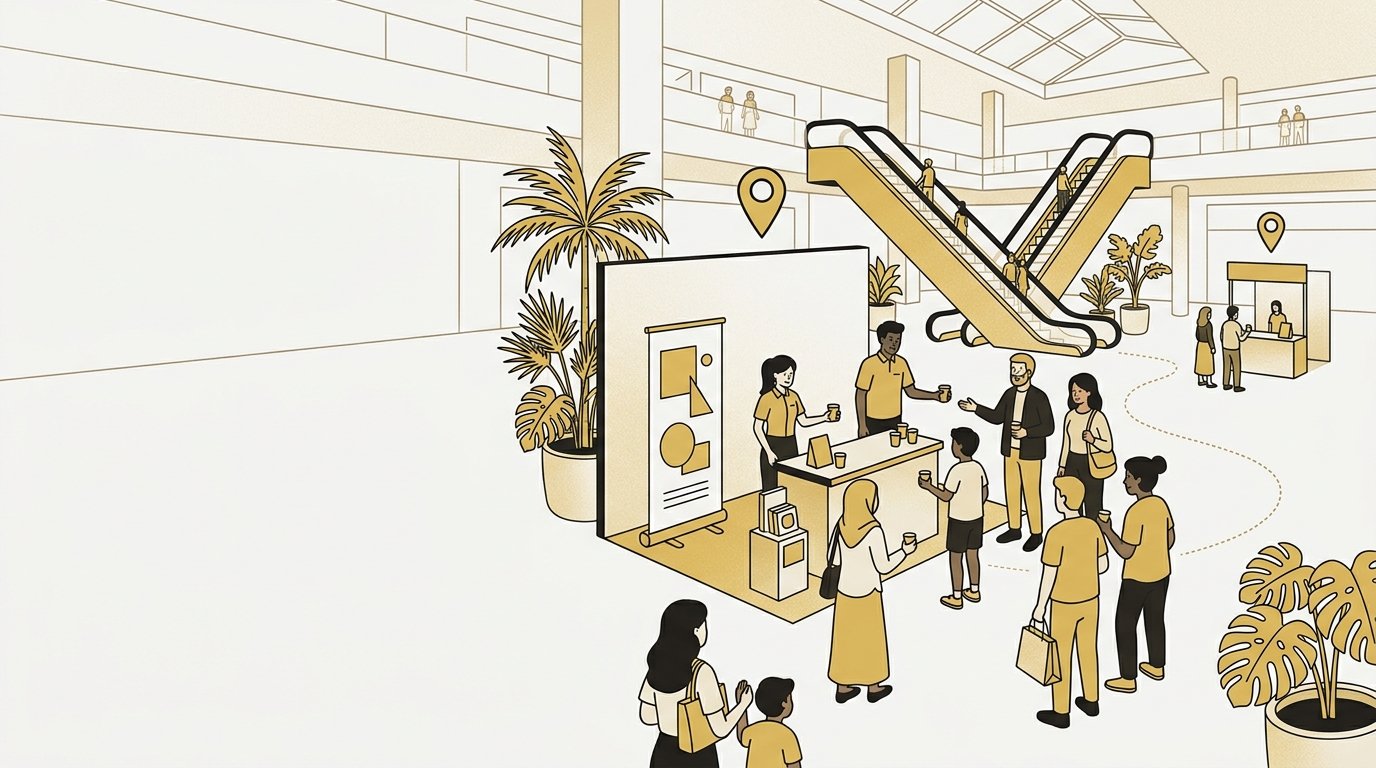
Four formats recur across the Indonesian agencies and articles that rank for this topic: sampling, mall roadshows and pop-ups, retail activation, and community or event activations.
Brand activation is a marketing activity that gets people to interact with a brand directly, usually in person, rather than just see an advertisement.
The evidence that this work moves purchases in Indonesia is thin but real. According to Kusuma and colleagues in the IECON-3 proceedings, published by Amerta Institute in 2025, a survey of 397 buyers of Hilo sachets in Malang City, Batu City and Malang Regency in East Java found that both ATL and BTL activities significantly influenced purchase decisions, and BTL had a slightly higher impact. That is one product in one region, measured by survey. It supports “BTL matters for everyday consumer goods” and nothing broader.
| Format | Best for | Prepare | Measure |
|---|---|---|---|
| Sampling | Low-priced products where trying is the main barrier | Sample stock, trained promoters, a short script, product rules for food and drink | Samples given, redemptions or purchases, sign-ups |
| Mall roadshow or pop-up | Launches and awareness across several locations | Venue terms for each stop, booth design, crew briefing, a schedule | Footfall, interactions, leads per location |
| Retail activation | Moving a product that is already on the shelf | Retailer agreement, display, staff, stock | Sell-through during the activation, redemptions |
| Community or campus event | Reaching a group with a shared interest | Event access, a clear fit between product and group, one offer | Sign-ups, engagement, follow-up conversions |
Sampling in minimarkets and modern retail
Sampling puts the product in a buyer’s hand at or near the point of purchase. A LinkedIn post by Rizky Aditya, a growth and performance head, names in-store sampling at Indomaret, a minimarket chain, as a typical Indonesian BTL activity. Mailchimp lists free sample campaigns among its BTL methods.
Sampling suits cheap, fast-moving products where trying is the barrier. That is the same category as the Hilo sachet study. If the sample is food or drink, read the halal and product-registration points further down before you order a single sample cup.
Mall roadshows and pop-ups
A roadshow moves a booth or stage between locations. A pop-up holds one place for a short time. This work is also called experiential marketing: promotion that lets people take part rather than watch. The agency F4Elements describes mall roadshows, product launches, experiential pop-ups and retail activations as the usual settings where creators are now expected to carry the on-ground experience online. Indonesia Investments (20 May 2025) cites two examples: SK-II’s padel court activation, and a Stranger Things pop-up by Netflix Indonesia in Blok M.
A roadshow multiplies logistics. Every stop has its own venue terms, set-up time and crew briefing. Gwenchana’s own service page lists mobile roadshows, mall exhibitions and interactive booths among the formats it runs.
Retail and in-store activation
In-store activation puts staff, displays or a demo inside the shop where people decide. Mailchimp describes it as displays, offers and urgency at the point of purchase. Rebound Ads uses IKEA’s in-store experience as its example. Neither adds Indonesian detail, so treat retail activation as a negotiation with each retailer: which space, which days, and who supplies the staff. Get all three in writing.
Community, campus and event activations
MCH Global lists campus sessions, community events, product launches, pop-ups and workshops among the activation formats it runs in Indonesia. These formats put you in front of a group that already shares an interest, which a mall corridor cannot do. They also ask more of you: the offer has to make sense to that group, or the booth sits empty.
Where KOL and KOC creators fit
Creators extend an activation online. F4Elements says creators are now expected to turn on-ground experiences into digital conversation, and Indonesia Investments recommends multi-tier campaigns that use KOLs (key opinion leaders) and KOCs (key opinion consumers). Plan the creator’s role with the event, not after it. KOL and KOC campaigns tend to work better when the booth gives the creator something to film.
How do you measure a below the line activation?
Pick one goal for each activation before it starts, then track the metric that matches the format: footfall and engagement for roadshows and pop-ups, redemptions and sell-through for sampling and retail, and leads for anything that ends in a sign-up.
| Format | Metric | How it is captured on the ground |
|---|---|---|
| Roadshow or pop-up | Footfall | A counter at the entrance or a staff tally per hour |
| Roadshow or pop-up | Engagement | Interactions, games played, queue time at the booth |
| Any format | Leads | A sign-up form or QR code tagged with the activation and location |
| Sampling | Redemption | A unique coupon code or QR per location |
| Retail activation | Sell-through | Sales of the product during the activation, compared with the same shop’s normal weeks |
| Community or campus event | Follow-up conversion | Sign-ups matched to later purchases |
Gwenchana’s service page lists footfall tracking, engagement metrics and collected leads among its post-event deliverables, so those three are a reasonable minimum to ask any partner for.
A footfall count looks impressive and says little by itself. A busy corridor can produce many passers-by and few leads. Pair it with a conversion rate, meaning leads divided by the people who stopped, and compare locations on that number rather than on crowd size.
The survey result above also has a limit here. It measures how much BTL influenced purchase decisions, not what happened at a booth. For the booth, you need your own numbers. Tag every lead with the activation and the location, then connect leads to CRM pipeline stages so you can see which activation produced customers and not just sign-ups.
What a foreign brand needs before activating in Indonesia
Before activating, a foreign brand has to settle three things: who organizes the activation, what approvals the city and venue require, and whether the product meets Indonesian rules.
Indonesia Investments (20 May 2025) says international brands often struggle with execution speed and cultural nuance, and recommends partnering with a local marketing agency. The article promotes its own agency, but the rules below make the same point on independent grounds.
Who can organize the event
According to RRI, citing Antara, 24 July 2026, Indonesia’s Directorate General of Immigration restated that foreign nationals may not act as independent event organizers. They can take part in support roles, such as official crew or as part of an international team. The statement followed a running event in Bali. Two Dutch nationals were barred from re-entering Indonesia and placed on the immigration blacklist after allegedly organizing it.
The rule concerns who organizes an event. It does not say how a brand’s marketing staff may take part. For a foreign brand, the practical reading is to let an Indonesian-based organizer lead and keep your own team in a support role. Confirm the details with immigration authorities or a local lawyer, because this is a compliance question, not a marketing one.
Permits, venues and crew
Whether an activation needs police, venue or local-government approval depends on the city, the venue and the expected crowd. This guide does not list permit steps because they differ between places and change. A partner on the ground can tell you what applies to your city and venue today. Verify current requirements with the local authority, and treat nothing here as legal advice.
Ask the venue for its terms on set-up times, power and signage before you pay a deposit. For crew, hire promoters and brand ambassadors who speak Indonesian and, where it matters, the local language. Brief them and supervise them locally. The conversation at the booth is theirs, and they cannot carry it from a script written in Singapore.
Food and drink sampling: halal and product registration
Halal certification deadlines fall in October 2026, which matters for any sampling plan that includes food or drink. According to Antara, 10 June 2026, Ahmad Haikal Hasan, head of the halal agency BPJPH, said mandatory halal certification extends to food and beverage products from micro and small local businesses and to imported goods, with a deadline of 18 October 2026. Some reports give 17 October, so confirm the date with BPJPH.
Whether a free sample falls under the rule is a question for BPJPH or your partner, not something to assume either way. Food products also face product-registration rules, so ask which apply to the sample you plan to hand out.
Before you book anything
Not sure who should organize your activation in Indonesia?
Who organizes the event, which approvals apply and how food samples are handled all depend on your city, venue and product. Talk them through with the Gwenchana team before you commit to a date.
Book a free consultationHow to choose an on-ground partner in Jakarta
Choose a partner by asking who does each task and getting the answer in writing, then by asking for evidence of similar work. A BTL marketing agency plans and runs activations such as sampling, roadshows and events. Directories like Sortlist and RevenueBase list Indonesian activation agencies, but a list is a starting point, not a comparison.
- Ask which parts the agency runs itself and which it subcontracts: booth fabrication, promoters, venue booking, documentation.
- Ask who handles permits and venue approvals, and what happens if one is delayed.
- Ask who briefs and supervises the crew on site.
- Ask what you receive after the event: counts, photos, leads, a debrief.
- Ask how leads reach your CRM or sales team.
- Ask for one example of a format similar to yours and what the client wanted from it.
Gwenchana’s on-ground activation in Indonesia page lists concept and strategy, booth design and fabrication, brand ambassador management, gamification, and event documentation with post-event reports and lead collection. The formats listed are mall exhibitions, trade shows, brand activations, product launches, mobile roadshows and interactive booths. Gwenchana sells this service, so put the same six questions to us. The page does not list permits or venue sourcing, so ask about those two in particular.
How to plan a first pilot
Run the first pilot as one format, in one city, for a short period, against one goal you can count.
- Set the goal. Sign-ups, trial, or sales of one product. Pick one.
- Choose the format from the table above. If the product is cheap and new to buyers, sampling is the simplest test.
- Choose one location and one venue. Fix the terms in writing.
- Set the timing. Campaign Asia has reported that Bank Negara Indonesia invited six agencies to pitch for its below-the-line account in preparation for Ramadan, which is one sign that BTL planning there follows the calendar.
- Decide the measurement before the first day: footfall, engagement, leads, redemption, whichever matches the format.
- Review against the goal, change one thing and decide whether to repeat.
Treat the first pilot as a test you can fail cheaply. If lead capture is running well under your target by the second day, change the offer or the booth position then, not at the debrief.
Plan your activation in Indonesia with Gwenchana
Below the line marketing in Indonesia works best when the format, the rules and the measurement are settled before the booth goes up. If you are a brand in Singapore, Malaysia or the Philippines weighing a first activation, book a free consultation with the Gwenchana team to plan an activation in Indonesia. You can also read how the on-ground activation in Indonesia service is set up before you talk to us.
Plan your first activation
Plan your activation in Indonesia with Gwenchana
Bring your product, your target city and one goal. The Gwenchana team will talk through the format, the measurement and the first pilot with you.
Book a free consultation