

Yes. Facebook Ads still work in 2026, but the platform is no longer the deciding factor. Execution, audience fit, and how you handle post tracking measurement now matter more than the algorithm itself. Campaigns that skip Conversions API or skip real audience testing tend to fail, while the ones built around today’s tools still produce trackable, defensible ROAS.
This article breaks down exactly what changed with Facebook Ads in 2026, why tracking makes working campaigns look broken, and the specific checks that separate a genuinely failing account from a misreporting one. You’ll also get real 2026 benchmark data, a Facebook Ads versus Google Ads comparison, and what this means for businesses in Indonesia specifically. Stay with it to the end, since the real answer isn’t just yes or no, it’s which of the conditions below your own campaign is missing.
Why “does Facebook Ads work” is the wrong question in 2026
Type “do Facebook ads work” into Google and you’ll find five near identical answers: yes, with a case study attached. HawkSEM says yes. LYFE Marketing says yes, “110%.” WebFX says yes, backed by four client logos. None of them explain why the question keeps coming up in the first place.
It comes up because the platform changed underneath advertisers, not because it stopped working. Since Apple’s App Tracking Transparency (ATT) rollout, Meta has been rebuilding how it measures results, and a lot of businesses are still running campaigns designed for the old measurement stack. The ads didn’t get worse. The visibility into whether they’re working did.
That distinction matters more than the yes/no framing most articles use. A campaign built on outdated tracking looks broken even when it’s converting fine; the conversions just aren’t visible. A campaign built on 2026’s tools, with the right audience and creative, still performs. The setup is the variable, not the platform.
This isn’t a minor technical footnote. It changes how you should read every “Facebook Ads ROAS” claim you see, including the ones in this article. A 3:1 ROAS quoted without an attribution window attached is close to meaningless in 2026 data conditions. So before getting into whether Facebook Ads work, it helps to look at what actually changed.
What actually changed: iOS tracking and why ads feel less effective
In April 2021, Apple introduced App Tracking Transparency, an opt in prompt asking iPhone users whether apps, including Facebook and Instagram, could track them across other apps and websites. Most people said no.
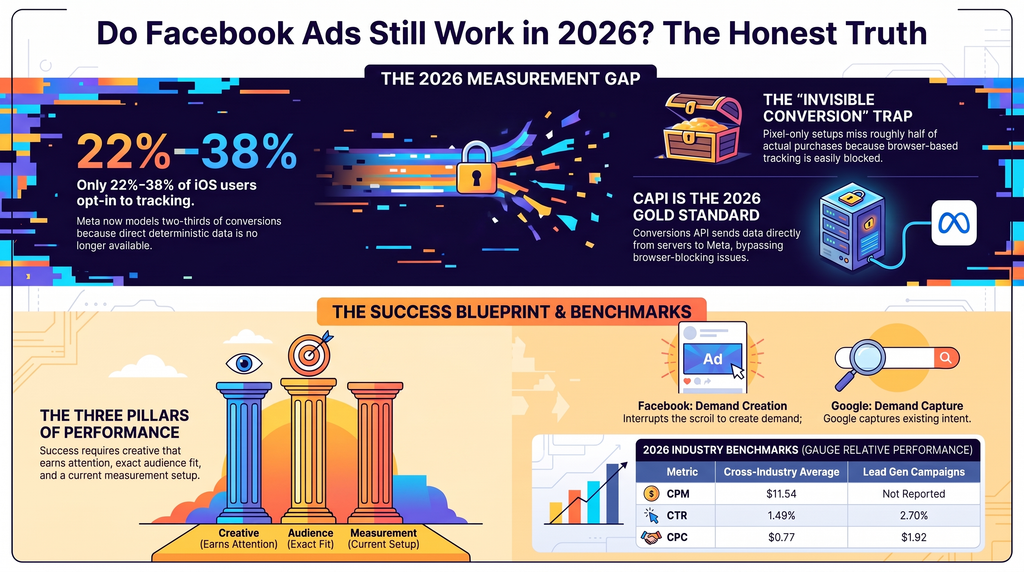
According to AppsFlyer’s 2026 tracking data, global opt in rates have settled between 27% and 38%, depending on region and measurement methodology, after climbing slowly from around 21% in 2022. Business of Apps’ 2026 benchmark puts regional opt in rates at:
- United States: 31%
- European Union: 22%
- Japan: 38%
That means Meta’s ad platform now has direct, deterministic data on roughly a third of iOS conversions, sometimes less. The other two thirds get estimated through modeling, not measured directly. If your reporting dashboard still assumes 2020 era tracking coverage, a campaign that’s actually working will show a ROAS that looks unconvincing.
This is also where attribution windows quietly change the story.
What is an attribution window?
An attribution window is the time period Meta uses to credit a conversion back to an ad click or view, commonly 7 days after a click or 1 day after a view by default. Shorten it and ROAS drops, because slower buyers stop counting; lengthen it and ROAS climbs, because more of the customer journey gets credited to the ad. Two advertisers running identical campaigns can report wildly different ROAS numbers simply because they set this differently. A flat benchmark like “aim for 3:1” means little without knowing which window it’s measured against.
A campaign selling a Rp 2 million skincare bundle with a 5 day average consideration period reports differently under a 1 day view window than under a 7 day click window, not because performance changed, but because the measurement did. This is the gap that convinces business owners Facebook Ads “stopped working” when what actually happened is their reporting stopped matching reality. Before concluding a campaign is underperforming, check which attribution window the ad set is using and whether it matches how long customers actually take to buy.
How Meta closed the tracking gap: Conversions API and Aggregated Event Measurement
Meta didn’t just accept the tracking loss. It built two systems to work around it, and most of the “does Facebook Ads work” debate ignores both.
What is Conversions API?
Conversions API (CAPI) is a way to send conversion data directly from a server, website platform, or CRM to Meta, instead of relying only on the browser based Pixel. According to Meta for Developers’ documentation, CAPI connects events like purchases, leads, and offline sales to Meta’s systems so the platform can keep optimizing delivery and measuring outcomes even when browser tracking is blocked or limited. The Pixel watches from the browser and gets blocked; CAPI reports from the server and doesn’t.
What is Aggregated Event Measurement?
Aggregated Event Measurement (AEM) is Meta’s protocol for measuring web and app events from iOS 14.5+ users, including those who declined tracking, without collecting individually identifiable data. Meta’s documentation notes that recent updates removed the old 8 event limit and the manual prioritization step; AEM now aggregates eligible events automatically, without an advertiser configuring anything by hand.
Together, these two systems are the difference between a Facebook Ads account that “stopped converting” and one that’s just reporting less than it used to. A business running Pixel only tracking in 2026 is missing a meaningful share of its own conversion data, not because the ads failed, but because the measurement layer never caught up to iOS 14.5.
This is usually the point where a marketing team starts asking whether the budget is even worth defending. It’s a fair question, and usually the wrong fix. Before cutting spend, it’s worth checking whether CAPI is actually installed and firing, since plenty of accounts have it half configured, sending some events and silently dropping others.
A common gap: an account with the Pixel installed in 2019, never touched since, and no CAPI events firing at all. On paper the ROAS looks flat. In reality, half the purchases are invisible to the ad account.
If the account isn’t capturing conversions correctly, that’s worth a second look before any budget decision.
Tracking check
Not sure if your Pixel and Conversions API are actually catching conversions?
We’ll check your Meta Ads account for CAPI setup, attribution window, and whether conversions are being reported accurately, then hand you a realistic ROAS read before you spend another rupiah.
Get My Free Campaign ReviewSo, do Facebook Ads work? Yes, if these three things are true
Strip away the tracking discussion and the question comes down to three conditions:
- The creative earns attention
- The audience actually wants what’s being sold
- The measurement setup is current
Meet all three and the platform performs. Miss any one and no amount of budget fixes it.
Creative quality matters more than most advertisers assume, because Meta’s delivery system rewards engagement signals before it rewards a bid. An ad nobody stops scrolling for gets throttled regardless of budget size. Audience fit matters because Meta’s targeting, however advanced, can only work with the signals it’s given; broad targeting on a narrow product wastes spend as reliably as narrow targeting on a mass market product does. Measurement matters for the reasons covered above: a campaign performing well but reporting poorly gets killed by a manager who trusts the dashboard over actual sales numbers.
2026 Facebook Ads benchmarks by campaign type
According to WordStream’s 2026 Facebook Ads Benchmarks report:
| Metric | Cross-industry average | Lead generation campaigns |
| CPM | $11.54 | not reported separately |
| CTR | 1.49% | 2.70% |
| CPC | $0.77 | $1.92 (median) |
The spread between industries is wide, from a $5.61 CPM in apparel to $28.40 in finance. WordStream also notes lead campaigns improved this year, with an 11% increase in conversion rate and a 6.25% drop in CPC compared to the year before.
Those numbers only mean something in context. A $28 CPM in finance isn’t a sign the platform failed a finance advertiser; it reflects auction competition in a category where customer lifetime value is high enough to justify the price. Judging Facebook Ads performance against one flat benchmark, ignoring industry and attribution window, is exactly how “do Facebook Ads work” turns into a myth instead of a math problem.
None of this is instant. Meta’s delivery system needs a learning phase, usually around 50 conversions in a week, before it optimizes properly, and increasing budgets by more than 20% at once can reset that phase and temporarily tank performance. Plenty of “this platform doesn’t work” verdicts get written during exactly that window. If the auction mechanics are new to you, our guide on how Facebook Ads work covers the basics.
Facebook Ads vs. Google Ads: which fits your business stage?
Neither platform is universally better; they solve different problems. Google Ads captures demand that already exists, since someone searching “meta ads agency jakarta” has already decided to look. Facebook Ads creates demand: it interrupts a scroll to introduce a product or service the viewer wasn’t actively searching for.
| Facebook Ads | Google Ads | |
| Best for | Discovery, brand awareness, visual products | Capturing existing search intent |
| Typical buyer stage | Cold to warm | Warm to ready to buy |
| Cost driver | Audience size, creative quality, engagement | Keyword competition, Quality Score |
| Measurement challenge | Post ATT tracking gaps (see above) | Less affected: search intent is self reported |
| Best fit business stage | Building awareness, testing new audiences, visual and lifestyle products | Established demand, clear buyer keywords, higher ticket B2B |
For a new lifestyle brand nobody has heard of yet, Facebook Ads earns its budget by creating that first spark of awareness, and retargeting ads on Facebook are usually the cheapest way to bring those warm visitors back. For an established B2B service where buyers already know they need it and are actively comparing vendors, Google Ads often captures that decision more cheaply than Facebook can manufacture it. Most businesses asking “do Facebook Ads work” are really asking whether it’s the right tool for where their business is right now, and the honest answer depends on which side of this table their buyer sits on.
If it’s unclear which side of that table describes your business, that’s worth figuring out before committing budget to either platform.
Platform fit check
Still deciding between Facebook Ads and Google Ads for your business stage?
Our team reviews your funnel and buyer stage, then recommends the platform mix that actually fits, backed by your own account data instead of a generic rule of thumb.
Talk to Our TeamWhat this looks like in Indonesia
Indonesia isn’t a rounding error market for Meta; it’s one of the platform’s largest. According to DataReportal’s Digital 2026: Indonesia report:
- Around 230 million internet users, an 80.5% penetration rate
- Roughly 122 million active Facebook users, the third largest market globally
- 180 million total social media identities, or 62.9% of the population, per We Are Social’s Digital 2026 Global Overview
That scale changes the cost benefit math for local businesses. A UMKM (small business) running Facebook Ads in Jakarta or Surabaya competes in an auction with genuinely massive reach available, but also with rising local competition as more businesses shift budget from print and radio to Meta. The tracking issues covered earlier apply here too; Indonesian iPhone adoption has grown steadily, and ATT opt out affects local campaigns the same way it affects U.S. or European ones.
What doesn’t fully transfer from Western benchmark data is buyer behavior. WhatsApp driven closing, Instagram first product discovery, and price sensitivity reward different creative and offer structures than a U.S. audience responds to. A benchmark CPM from a U.S. heavy data set is a reference point, not a target; local testing still decides what actually converts. That’s the part generic benchmark articles skip, and it’s usually where the real answer to “do Facebook ads work here” gets decided.
What a real campaign audit actually checks
Most “Facebook Ads work” articles end with a client’s percentage lift chart and no methodology behind it: a 62% ROAS increase with no stated attribution window, no time frame, no mention of what changed. That’s marketing copy, not evidence, and it’s part of why skeptical business owners keep asking whether the platform actually works.
A campaign review that means something checks specific things, in this order:
- Whether Conversions API is installed and firing, not just the Pixel
- What attribution window the account is reporting under
- Whether the ad account is still in, or repeatedly re-entering, the learning phase
- How creative performance breaks down by placement
- Whether the audience being targeted matches who’s actually converting
Run through that list on an underperforming account and the picture usually looks different than the dashboard’s headline ROAS number suggests. Sometimes the ads genuinely aren’t working: wrong audience, weak creative, no real product market fit. But often the ads are converting fine and the account is misreporting them, because nobody checked CAPI status after the last iOS update or because the attribution window doesn’t match how long the buyer actually takes to decide.
That’s a different problem than “Facebook Ads don’t work,” and it needs a different fix than pausing the campaign. If you do decide to step away from the platform, here is how to delete a Facebook ad account.
Meta’s own numbers back up why the platform is still worth this level of scrutiny rather than an outright pause. According to Meta’s Q2 2026 investor results, advertising revenue grew 27% year over year to $59.36 billion, and the average price per ad rose 12%, numbers that only make sense if enough advertisers are still getting a return worth paying more for. A platform in genuine decline doesn’t see advertisers bidding prices up.
The bottom line
Facebook Ads work in 2026 the same way they always have: for businesses that treat the platform as a system to configure correctly, not a slot machine to fund and hope. What changed is tracking, not effort. The tools to work around it exist, and the businesses still asking “do Facebook Ads work” are usually the ones running a 2020 tracking setup on a 2026 platform.
If you want an honest read on your own account instead of another generic benchmark, we’ll review one live campaign, checking Conversions API setup, attribution window, and audience fit, and give a realistic ROAS estimate before you commit more budget to scaling it. See how our Meta Ads management approach handles this, or read more on how Meta Ads work for B2B and why an Instagram ad stops delivering before your next campaign launch.
Free campaign review
See what your Facebook Ads account is really doing before you scale it
We’ll review one live campaign, covering Conversions API setup, attribution window, and audience fit, and give you a realistic ROAS estimate at no cost.
Get My Free ReviewGwenchana Digital Solusindo