
By Lawrence Philemon · Reviewed by Lim Peter, Founder & Branding Consultant, Gwenchana Digital · Last updated: 8 October 2026
A rebranding agency helps a business change how the market sees it. Depending on the problem, that can mean a visual refresh, a repositioning or a full rebrand. Work usually starts with an audit of what customers already recognise, then moves through strategy, messaging, identity and rollout. The right partner tells you which scope you actually need.
This guide is for business owners and marketing leads in Singapore, Malaysia and the Philippines who suspect their brand no longer fits the business. It covers the signs worth acting on, the difference between a refresh and a full rebrand, what you can lose, and how to judge any rebranding agency before you sign. One disclosure up front: Gwenchana provides branding consultation, so this guide names no other agencies and ranks no one.
What a rebranding agency actually does
A rebranding agency changes how an existing business is understood by its market, which can mean new positioning, new messaging, a new visual identity or, in some cases, a new name.
Rebranding is the process of changing how an established business is perceived by updating some combination of its positioning, messaging, visual identity and name.
The work usually falls into four parts:
- An audit of how customers, staff and competitors currently see the brand, and which assets people already recognise
- Positioning: who the business serves, what it wants to be known for, and why a buyer should believe it
- Identity: the words (messaging, tone of voice, sometimes a name) and the visuals (logo, colour, type, imagery)
- Rollout: guidelines, templates and the order in which every touchpoint changes over
A branding agency and a rebranding agency do overlapping work, with one difference. A brand built from scratch has nothing to protect. A rebrand starts with years of recognition, search traffic and customer habits, and the agency’s first job is to work out which of those to keep.
Signs your brand needs a refresh (or more)
A business usually needs to look at its brand when what it sells, who it sells to or where it sells has changed, but its name, message or look has not.
Watch for these signals:
- Sales conversations open with explaining what the company actually does
- You’ve moved upmarket, or from consumer to B2B, but the brand still signals the old customer
- You’re expanding into a new country and the name or story doesn’t travel
- After a merger, customers see two brands and aren’t sure which one they’re buying from
- The visual identity looks dated next to competitors, even though the positioning is still right
- Another company uses a similar name, or a trademark check turns up a conflict
- Ask five people on your team what the company stands for and you get five different answers
Most companies tick two or three of these at once. The one to act on first is the one costing you sales or causing confusion, and each points to a different scope:
| Signal | Likely scope | First step |
|---|---|---|
| Looks dated, positioning still right | Refresh | List which visual assets customers recognise |
| Customers misunderstand what you offer | Repositioning, messaging first | Interview customers and the sales team |
| New audience or price point | Repositioning, often with visual changes | Define the new target buyer and what you want to be known for |
| Entering Singapore, Malaysia or the Philippines | Repositioning, plus a name check | Run trademark and name checks in the new market |
| Merger or acquisition | Full rebrand or a brand architecture decision | Decide which brand leads and how the others relate to it |
| Business pivot | Full rebrand | Settle positioning before any design work |
| Name conflict | Name change | Trademark clearance before anything else |
Refresh, reposition or full rebrand: which one fits
A brand refresh changes how the brand looks and sounds, a repositioning changes what it claims and to whom, and a full rebrand changes both, sometimes including the name.
A brand refresh is an update to visual or verbal elements that keeps the brand’s existing positioning intact.
Brand repositioning is a change in what the brand claims and who it targets, which may not involve any change to the logo at all.
| Scope | What changes | What usually stays | Typical trigger | Risk to existing recognition |
|---|---|---|---|---|
| Refresh | Logo refinement, colour, type, imagery, templates | Name, positioning, core message | Identity looks dated or inconsistent | Low |
| Repositioning | Target audience, value proposition, messaging | Name, often the logo | Audience, market or competitive context shifted | Medium |
| Full rebrand | Positioning, messaging and visual identity together | Sometimes the name, sometimes nothing | Pivot, merger, outgrown identity | High |
| Name change | The name, and everything printed with it | Positioning, if it still works | Legal conflict, expansion, merger | Highest |
The smallest change that solves the business problem is usually the safer choice. Repositioning often comes first anyway, since a new logo built on unclear positioning just gives the old problem a new look.
What a rebrand puts at risk
The main risk in a rebrand is losing the recognition customers already attach to your name, colours, symbols and tone, and in some cases the search traffic tied to them.
Brand equity is the value a brand holds in customers’ minds, such as awareness, associations and perceived quality, which a rebrand can strengthen or erode. Kevin Lane Keller’s customer-based brand equity model traces it to two things: how easily people recall the brand and what they associate with it.
Distinctive brand assets are the non-name elements, such as colours, shapes, characters, taglines and sounds, that people use to recognise a brand. The term comes from Jenni Romaniuk’s research at the Ehrenberg-Bass Institute, set out in her book Building Distinctive Brand Assets.
Two well-documented cases show how fast recognition can go. According to Fortune, citing Ad Age and Information Resources Inc. data, Tropicana Pure Premium’s unit sales fell 20% between 1 January and 22 February 2009 after a packaging redesign, and dollar sales dropped 19%. The brand went back to its original packaging. Gap’s case was even quicker: The Christian Science Monitor reported on 12 October 2010 that Gap withdrew its new logo one week after introducing it, following more than a thousand negative comments on its Facebook page.
Neither company lacked design talent. Both changed the assets customers used to find them on a shelf or a screen.
Recognition you’ve already earned
Before anything changes, list every asset a customer might recognise: the name, the logo shape, the main colour, a tagline, packaging, even a recurring photo style. Then sort each one into keep, evolve or drop. If the audit can’t say which assets carry recognition, the design stage will guess, and guesses are how a redesign ends up like Tropicana’s.
Search visibility after a name or domain change
A new name often means a new domain, and that puts your search rankings at stake. Every old URL needs a 301 redirect to its new equivalent, and Google Search Console’s Change of Address tool should be used for the move. Google’s own guidance says to keep those redirects for at least 180 days, longer if traffic still arrives through them, and notes that combining a site move with a redesign will probably cause some traffic loss while Google reassesses the pages. If organic search brings you leads, plan how to protect your search rankings during a name or domain change before launch day, not after it.
Name changes and trademarks in Singapore, Malaysia and the Philippines
A new name has to be clear to use in every market you sell in. That means trademark searches with IPOS in Singapore, MyIPO in Malaysia and IPOPHL in the Philippines, plus updating your business registration (with ACRA, for a Singapore company). Have a trademark professional check the shortlist before anyone designs a logo around it.
The rebranding process, stage by stage
A strategy-led rebrand moves from audit to strategy to verbal identity to visual identity to guidelines and rollout, with a decision to sign off at the end of each stage.
1. Brand audit
The agency reviews how the brand is seen today: interviews with leadership, the sales team and a handful of customers, a scan of competitors, and an inventory of every asset in use. The decision at the end is what stays, what is broken, and which scope from the table above fits.
2. Strategy and positioning
This stage defines the target buyer, what the brand should be known for, how it differs from competitors and what proof supports the claim. Leadership signs off a positioning statement here. Skipping this sign-off is the most common cause of delays later, because design work built on unsettled positioning usually has to restart.
3. Verbal identity
Messaging comes next: the core message, supporting points, tone of voice, a tagline if one is needed, and naming if the scope includes it. The decision is an approved message set and, for a name change, a cleared name.
4. Visual identity
The logo is refined or redesigned, along with colour, typography and imagery. A useful check at this stage is to put the new identity next to the old one and ask a few customers whether they still recognise the company. The decision is the final identity direction.
5. Guidelines and rollout
Guidelines and templates make the new identity usable by your own team. The rollout plan lists every touchpoint in priority order: the website, sales decks, social profiles, signage, packaging. Staff should hear about the rebrand before customers do. Many rollouts also mean having to rebuild the website around the new brand, so that work belongs in the plan from the start.
The decision here is the rollout order and a cut-off date for old assets.
6. Post-launch measurement
Compare branded search volume, direct traffic, enquiry quality and the questions customers ask against the numbers you recorded before launch. Without that baseline, nobody can say whether the rebrand worked.
Not sure which stage you need?
Get a second view on your rebrand scope
The audit and positioning stages decide whether everything after them holds up. Gwenchana’s branding consultation covers a brand discovery and competitive audit, positioning and messaging, visual identity direction, and brand guidelines with an activation roadmap. A free consultation shows which of those stages your brand actually needs.
Book a free rebranding assessmentHow to choose a rebranding agency
Choose the agency type that matches the scope you need, then check that it audits before it designs and can show how it protected existing recognition in past rebrands.
Many “best rebranding agency” lists are published by agencies that rank themselves first. Use them to find names, not to decide. Matching the type of agency to your scope narrows the field faster:
| Agency type | Best for | Skip if |
|---|---|---|
| Design studio | Refreshes and visual identity work | You need repositioning or naming |
| Strategy-led brand consultancy | Repositioning, full rebrands, mergers | You only need new templates quickly |
| Full-service or advertising agency | A rebrand tied to a large launch campaign | Most of the budget needs to go into positioning, not media |
| Digital-first or web agency | A rebrand centred on the website or product | The real problem is positioning, not the site |
Then put the same questions to every agency on the shortlist:
- Who will do the positioning work, and will that person stay on the project through rollout?
- What happens before you show any design?
- Show us a rebrand where you kept something the client already owned. Why did you keep it?
- How do you test whether customers still recognise the brand?
- What does rollout support include?
- Who owns the final files, source designs and font licences?
- Where can we read reviews from past clients outside your own website?
Some answers should end the conversation. Logo concepts in the first meeting, a portfolio where every client looks the same, or a process the team can’t explain are all reasons to move on. For a longer scorecard, see our guide on how to evaluate an agency before you sign.
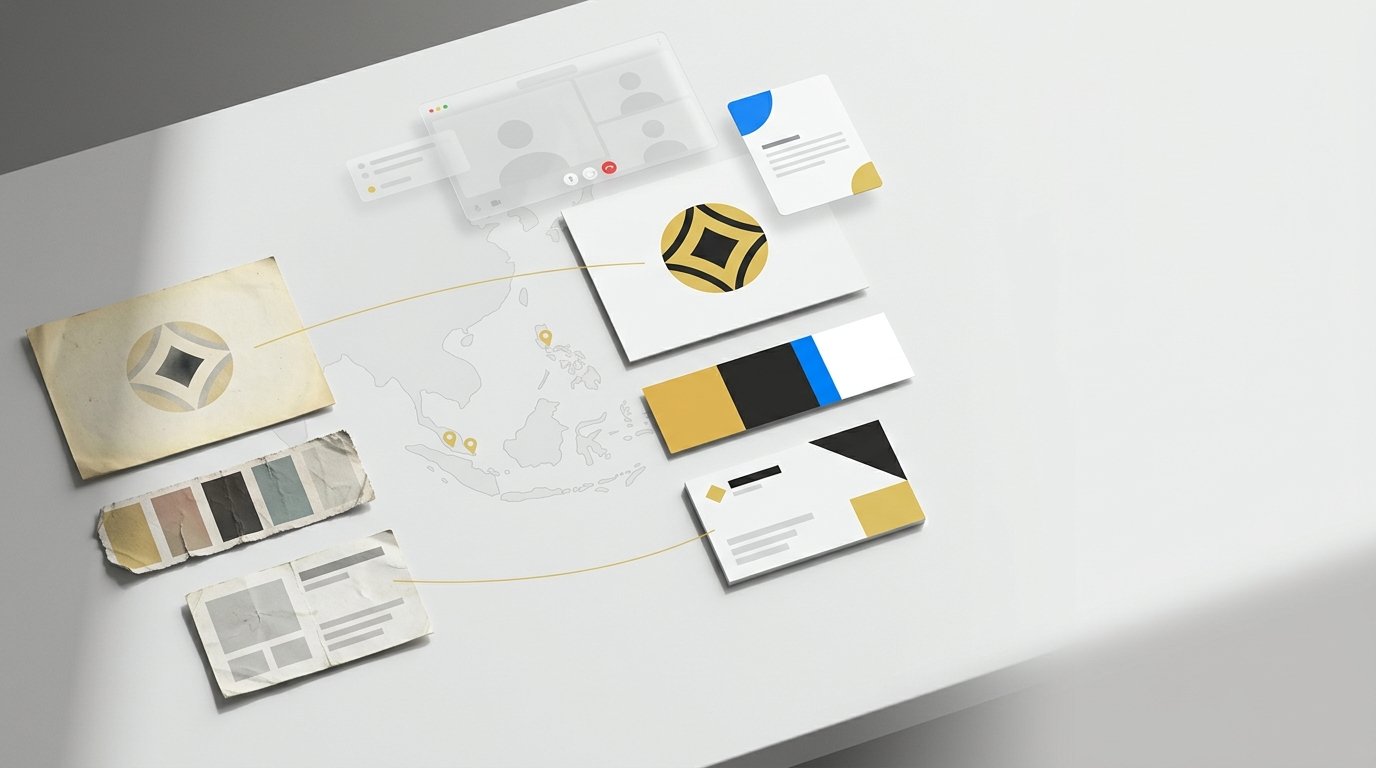
Working with a rebranding agency remotely across Singapore, Malaysia and the Philippines
A rebrand can run remotely when interviews, workshops and approvals are planned around the stakeholders’ calendars, and the one-hour gap between Jakarta (UTC+7) and Singapore, Kuala Lumpur and Manila (UTC+8) keeps scheduling simple.
Here is how Gwenchana runs it from Jakarta. Meetings, audit interviews and positioning workshops happen on Google Meet. Working documents and sheets live in Google Workspace, so both teams edit the same files instead of emailing versions back and forth. Day-to-day messages go through whichever channel the client already uses, WhatsApp or Slack for example, as long as both sides are comfortable with it.
Remote work does change the process. Review rounds happen in shared documents rather than in a meeting room, so the client side needs one person with authority to approve each stage. Workshops also lose some of the energy of a whiteboard session. Shorter sessions with prework sent in advance make up for most of it.
A local agency is the better choice in some cases:
- Your audience is hyper-local and the audit needs in-person research
- The rollout is heavy on physical work, such as retail fit-outs or signage, that needs someone on site
- You plan to fund the project with a grant that has rules about which providers you can hire
On grants: many Singapore guides still cite the Enterprise Development Grant, but Enterprise Singapore’s EDG page now says EDG, MRA and PSG ceased on 29 September 2026 and directs applicants to the EDGE Grant. Check the current conditions with Enterprise Singapore, including any requirements on who you hire, before you count on funding.
Getting a second opinion before you commit
A rebrand is easier to scope once someone has looked at the brand from the outside. If you’re weighing a refresh against a full rebrand and want that outside view, book a free consultation with the Gwenchana team for a rebranding assessment. We’ll look at where the brand stands today, which signals apply, and which scope fits, whether or not you end up hiring a rebranding agency. Start with our branding consultation page.
Free rebranding assessment
Talk to the Gwenchana team before you commit
Tell us what has changed in your business. We’ll review where your brand stands and help you decide between a refresh, a repositioning or a full rebrand, working remotely with teams in Singapore, Malaysia and the Philippines.
Book a free rebranding assessment