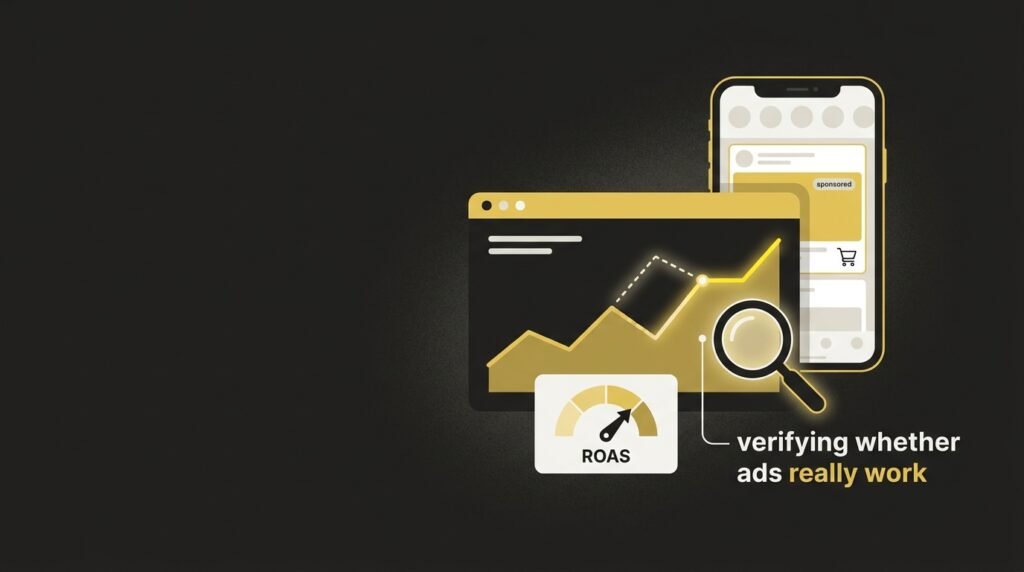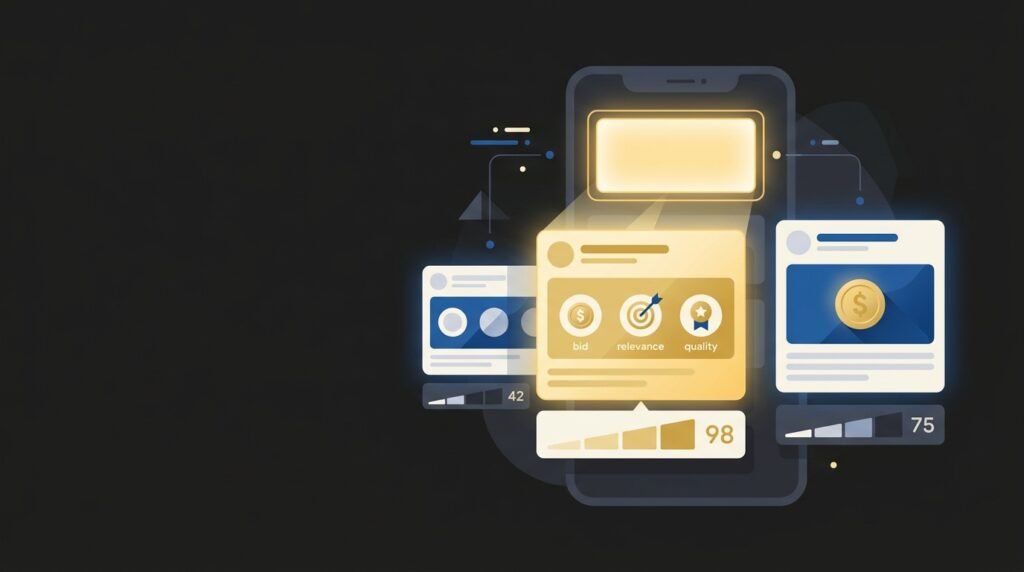

Digital advertising services manage paid campaigns across platforms like Google, Meta, and TikTok. The work covers strategy, tracking setup, weekly creative testing, and budget optimization. Rather than charging a flat fee, most providers structure the work in phases: setup, experimentation, then scaling, so cost stays tied to actual campaign performance.
What Are Digital Advertising Services?
Digital advertising services are a managed, paid-media offering that handles campaign strategy, setup, creative testing, and ongoing optimization across ad platforms, distinct from organic channels like SEO or content marketing. This is often grouped under the broader label of PPC (pay-per-click) management. A provider typically audits your existing accounts, defines campaign objectives, installs tracking (pixels and conversion events), and builds out the ad structure itself. From there, the work becomes iterative: testing audiences, creative, and placements against real performance data.
The distinction matters because paid and organic channels solve different problems on different timelines. Paid gets you in front of buyers this week. Organic compounds over months.
When Does Your Business Actually Need It?
Not every business needs digital advertising running at all times. Four signals usually mean it’s worth starting or revisiting:
- Lead volume has flattened or dropped
- Customer acquisition cost (CAC) is climbing
- Revenue depends on a single channel
- You’re entering a new market and need fast awareness
None of these require guessing. Each shows up in a dashboard before it shows up in revenue, which is exactly why tracking setup comes before any ad spend.
Digital Advertising Services vs. Digital Marketing Services
The two terms get used interchangeably, but they’re not the same scope of work.
| Digital Advertising | Digital Marketing | |
|---|---|---|
| Scope | Paid campaigns only | Paid + organic (SEO, content, social, email) |
| Timeframe | Results in weeks | Results compound over months |
| Cost structure | Always paid (media spend + management fee) | Mix of paid and free/in-house channels |
Advertising is the tactical layer. Marketing is the strategy that decides where advertising fits.
How the Work Actually Runs: The Weekly Optimization Framework
Most campaigns fail not from bad targeting but from no process for reacting to data. A working framework runs in three phases.
Week 0–1: Setup & Tracking
The provider audits existing accounts, defines the objective (awareness, leads, or sales), builds the campaign structure, installs pixels and event tracking, and sets the KPIs you’ll be judged against.
Week 2–3: Targeted Experiments
This phase tests audience, creative, and placement combinations against each other: static images against reels, one audience segment against another. Early CTR (click-through rate), CPC (cost per click), CVR (conversion rate), and CPL (cost per lead) or ROAS (return on ad spend) numbers start pointing to winners.
Week 4 and Beyond: Scale & Cost Control
Budget shifts toward whatever’s winning. Lookalike audiences and keyword lists expand. Creative gets refreshed on a set cycle, usually every 7 to 14 days for paid social, before frequency fatigue drives costs up.
This is clarity before virality: a named process beats chasing whatever performed well last week. Every week, you should get a performance summary (what changed, what it means, what happens next) plus dashboard access to the core metrics: impressions, CTR, CPC, CVR, CPL, and ROAS.
Which Channel for Which Goal
Channel choice should follow objective, not the other way around.
| Platform | Best For | Format | Key Metrics |
|---|---|---|---|
| Google Ads (Search, Performance Max, Display) | High-intent demand capture | Search ads on buyer-intent keywords, Performance Max, display | CPC, CVR, CPL, ROAS |
| Meta Ads (Facebook, Instagram) | Fast lead gen, content-based retargeting | Instant Form leads, static vs. reels testing, WhatsApp follow-up | CTR, CPL, cost per message, ROAS |
| TikTok Ads (Spark Ads, UGC) | Awareness and consideration | Spark Ads boosting creator content, three-second hook variations | Thumbstop rate, CTR, CPA, ROAS |
A B2B lead campaign might pair Google Search on high-intent keywords with a Performance Max layer to reach similar searchers. A D2C brand chasing add-to-cart volume might lean on TikTok Spark Ads and creator content instead. For more on structuring paid campaigns around a B2B funnel specifically, see our breakdown of B2B paid advertising.
Running Social Media Management alongside paid social means organic content and ad creative can feed each other instead of competing for the same audience’s attention.
Beyond these three, digital advertising services commonly extend to LinkedIn Ads and YouTube Ads for B2B and video-driven goals, Google Display Network and programmatic buys (DSP, RTB, private marketplace) for scaled awareness, Amazon Ads and Google Shopping for e-commerce, and dynamic remarketing to bring back visitors who didn’t convert. Which of these gets added depends on where your funnel is thin, not on running every channel at once.
How Much Do Digital Advertising Services Cost?
According to 2026 digital advertising cost benchmarks compiled by industry pricing guides including WebFX, small businesses spend an average of $2,083 per month, within a broader range of $301 to $5,000 per month depending on scope. Agency management fees typically run 15 to 20 percent of ad spend, or $500 to $1,500 per month layered on top of the media budget itself. That media budget is a separate line item, not something bundled into the management fee.
Most businesses allocate somewhere between 5 to 10 percent of total budget to paid channels, though smaller companies often run closer to 2 to 4 percent of revenue.
There’s no universal “good” CPL or ROAS. Benchmarks swing hard by industry and competition, which is why the Week 2 to 3 experiment phase exists: it establishes your own baseline before anyone commits to a scaling budget.
Service Packages, Scoped by Growth Stage
Starter Campaign One platform (Meta or Google), one objective: traffic, engagement, or leads. Includes 2 to 3 creative assets, basic tracking setup, daily monitoring, and a monthly report. Built for businesses still validating whether a paid channel works for them.
Growth Campaign Multi-platform (Meta, Google, TikTok) running a simple Awareness to Consideration to Conversion funnel. Includes 4 to 6 assets across static, reels, and motion, A/B testing on audience and creative, weekly reporting, and iteration against priority KPIs. Built for businesses that already have channel fit and want to lower CPL or lift ROAS.
Full Funnel Strategy Full ToFu-to-BoFu orchestration: audience research, messaging, ad and UGC production, landing page work (where website development support often comes in), analytics integration, and daily optimization. Built for brands managing multiple personas at scale who need tight cost control.
Not Sure Which Package Fits?
Starter, Growth, or Full Funnel, we’ll help you scope it right the first time.
If ad performance also depends on your organic presence, we can loop in SEO or Social Media Management at the same time.
Chat With Us on WhatsAppWhat We Need From You to Start
Efficient onboarding depends on a short list being ready upfront: access to Business Manager, ad accounts, and GA4; relevant pixel and event setup; brand assets (logo, colors, guidelines); a prioritized product or service list; communication do’s and don’ts; and a reporting cadence preference. Getting CRM and lead-nurturing tools connected at this stage also means leads don’t sit unfollowed while campaigns ramp up.
Is This Service Right for You?
It’s a fit if you’re ready to share account access and data, can produce and approve content on a reasonable timeline, want discipline around experiments and numbers, and will act on weekly iteration instead of waiting for a final report.
It’s not a fit if you expect instant results without validation, won’t allow tracking to be installed, or won’t adjust a landing page or offer when the data says it needs to change. For a broader look at vetting a partner before signing on, our guide on how to choose a B2B marketing agency covers the questions worth asking first.
Frequently Asked Questions
Digital advertising covers paid campaigns only: Google, Meta, TikTok, and similar platforms. Digital marketing is the broader strategy layer that includes advertising alongside SEO, content, and organic social.
Small businesses spend $301 to $5,000 per month on average, with management fees typically running 15 to 20 percent of ad spend on top of the media budget itself.
Early indicators, like CTR and CPC trends, usually show up within the first two to three weeks as initial audience and creative tests resolve. Stable, repeatable performance typically takes longer.
Not for every objective. Form leads and messaging campaigns can run without one, but a solid landing page still improves conversion rate and measurement accuracy for most other goals.
Access to your ad and analytics accounts, brand assets, a prioritized list of what you’re promoting, and sign-off on messaging guardrails.
It depends on whether you can sustain the testing phase. The first two to three weeks rarely show final numbers, and businesses that pull budget too early miss the phase where the data actually improves.
There’s no fixed benchmark since both metrics swing by industry and competition level. A working campaign should show its own improving trend from the Week 2 to 3 baseline onward, not match a generic industry number.
Yes, the terms are used interchangeably. Both refer to managed, paid campaigns across ad platforms, as opposed to organic channels like SEO.
Yes, Amazon Ads and Google Shopping (including Performance Max for Retail) are handled as part of the same channel-selection process, added when the objective is direct product sales rather than leads or awareness.
Yes. LinkedIn is added when the objective is B2B lead generation or account-based targeting, priced and scoped the same way as the Google, Meta, and TikTok channels already covered.
It’s added for businesses needing scaled awareness beyond what Google and Meta’s native ad managers reach, typically through a demand-side platform rather than as a default inclusion.
Ready to Scope Your Plan?
Success with paid campaigns comes down to a clear framework, disciplined experimentation, transparent metrics, and channels chosen to match your funnel, not more spend thrown at the problem. If you want to talk through your specific situation with our team and get a realistic execution plan for the next 4 to 8 weeks, book a consultation and we’ll help you map out where our Digital Advertising Services can move the numbers that matter to your business.