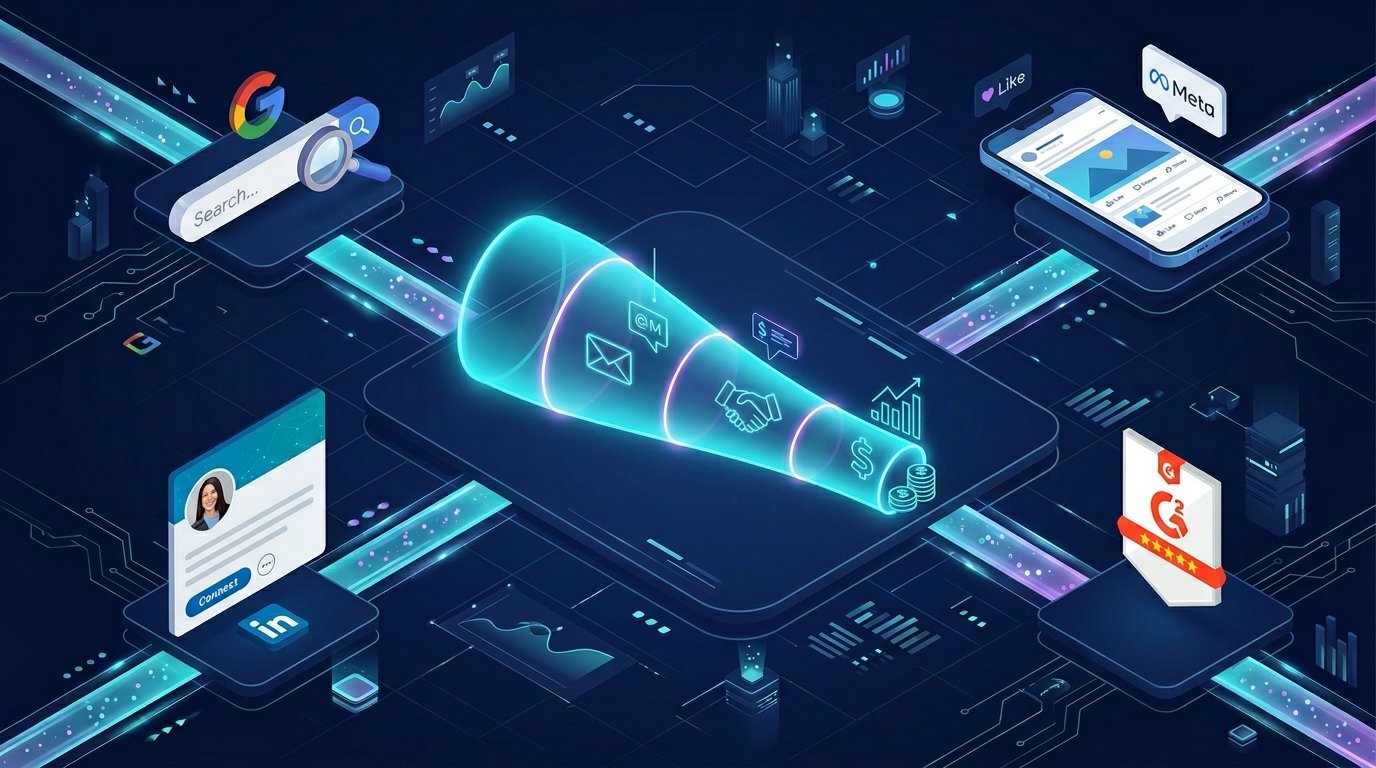

Quick answer: B2B paid advertising is the paid promotion of products or services to business buyers across six main channels: paid search, paid social, display and programmatic, sponsored content, review platforms, and podcast or newsletter sponsorships. Most companies run only one or two of these channels, which is a big reason their pipeline results stay inconsistent.
This guide was put together by the team at Gwenchana Digital, a Jakarta-based B2B performance marketing agency, from work with B2B clients across Indonesia and Southeast Asia.
By Lawrence Philemon, Head of Performance Marketing at Gwenchana Digital. Last updated June 2026.
If you sell to other businesses and you’re about to put real money behind ads, this guide is for you. At Gwenchana Digital, we manage B2B paid advertising for companies across Indonesia and Southeast Asia, from SaaS startups to enterprise service providers, and this guide collects what that work keeps teaching us. It looks simple from the outside: pick a platform, write an ad, set a budget. In practice, the companies that get consistent pipeline from ads treat their channels as one system, not a collection of separate campaigns. A LinkedIn campaign that loses money on its own can be the reason your Google retargeting converts three months later.
This guide walks through each channel, when it earns a place in your mix, how to split a budget across three realistic tiers, and how to decide whether to run it all yourself or bring in help.
The B2B paid advertising channel map: six channels at a glance
Before the channel-by-channel detail, here’s the full map. Per Gartner’s CMO Spend Survey data, B2B companies put a median 9.1% of revenue into marketing in 2026, and paid media is the largest single line inside that budget, around 30% by Directive’s 2026 benchmark roundup. Where that money can go:
| Channel | Best for | Typical entry budget | Funnel role |
|---|---|---|---|
| Paid search (Google, Bing) | Buyers actively searching for your category | $1,000+/month | Demand capture, bottom funnel |
| Paid social (LinkedIn, Meta, Reddit) | Reaching your ICP before they search | $1,000 to $3,000/month per platform | Demand creation, top and mid funnel |
| Display and programmatic | Retargeting and account-based plays | $2,000+/month | Mid funnel, staying visible during long cycles |
| Sponsored content | Borrowing a publication’s trust | Varies widely by publisher | Top funnel, credibility |
| Review platforms (G2, Capterra) | Software buyers comparing options | $500 to $2,000/month | Bottom funnel, high intent |
| Podcast and newsletter sponsorships | Niche audiences with high trust | $500 to $5,000 per placement | Top funnel, brand recall |
Two things stand out from this table. First, the channels do different jobs. Paid search captures demand that already exists. Paid social creates demand that doesn’t exist yet. Mixing up those jobs is the most common reason a channel “doesn’t work.” Second, almost every B2B guide you’ll read covers only the first three rows. Review platforms and sponsorships rarely get mentioned, yet for software companies and niche B2B categories they often produce the cheapest qualified pipeline of the whole mix.
Paid search for B2B: capturing demand that already exists
Paid search works when buyers know they have a problem and search for solutions in words you can bid on. If you sell accounting software, “accounting software for manufacturing” is a buyable moment of intent. The economics support it too. Google Ads remains the baseline for bottom-funnel B2B lead generation, with WordStream’s 2025 data putting the average B2B cost per lead at around $70.
Paid search fails in one specific situation: when your ICP doesn’t search for your solution by name. Early-stage categories live with this constantly. If you’ve invented a new way to do quality control, nobody is typing your category into Google because the category doesn’t exist in their head yet. Bidding on broad problem keywords in that situation burns money fast. Demand creation channels (paid social, sponsorships) have to come first, and search enters the mix once branded and category searches start appearing.
How are AI Overviews changing B2B paid search?
AI Overviews are pushing paid search further down the funnel. Seer Interactive analyzed over 3,000 informational queries and found a 68% drop in paid click-through rates where AI Overviews appear, and they now show on roughly half of searches. B2B tech queries have been hit especially hard. The practical move for 2026: weight your search budget toward high-intent commercial keywords where buyers are ready to act, and stop expecting informational-query ads to perform the way they did two years ago.
Paid social for B2B: LinkedIn, Meta, and the budget minimum question
The reflex answer here is “LinkedIn for B2B,” and it’s right often enough to be dangerous. LinkedIn’s targeting by job title, seniority, and company is unmatched, and Dreamdata’s 2026 benchmark report shows LinkedIn now takes 41% of total B2B ad budgets. The catch is cost. Sponsored Content runs $5 to $12 per click, and you need roughly $1,000 to $3,000 per month per campaign before the data tells you anything reliable. Spend less and you’re not testing, you’re donating.
Meta is the channel B2B marketers underrate, and the data explains both sides of the argument. Leads from Meta cost a fraction of LinkedIn’s, around $22 per lead in recent benchmarks, but only 5 to 10% of them typically qualify as sales-ready. That math can still work. It depends on whether your ICP is actually on Meta and whether you feed lead quality data back to the platform (more on that in the measurement section). The most common failure mode, as Italian agency HTT puts it, is building B2B Meta campaigns like B2C campaigns with a professional tone. They end up working for neither audience.
There’s also a regional layer that US-centric guides skip entirely. In Southeast Asia, LinkedIn’s professional audience is thinner than in the US, while Meta platforms reach a much larger share of business decision-makers, especially at SMEs. Research on B2B lead generation in Asia consistently finds that SME buyers in the region run shorter, more price-sensitive decision cycles, and that trust and localized content matter more in markets like Indonesia. At Gwenchana, when an Indonesian B2B client sells to SME buyers with a cycle under three months, we usually test Meta ads for B2B before LinkedIn, then add LinkedIn once the deal sizes justify its costs. The “LinkedIn for B2B” rule was written for San Francisco, not for Jakarta.
For a deeper breakdown of formats, audiences, and creative by platform, see our guide to B2B paid social advertising.
Display and programmatic: underrated, but not for cold traffic
Display gets a bad reputation from one number: cold display CTRs in B2B sit around half a percent. Judged as a cold traffic channel, it deserves the reputation. Judged as a retargeting and account-based channel, it’s one of the most efficient line items you can run. Retargeting campaigns average around 4.2x return on ad spend, and segmented retargeting (pricing-page visitors getting different ads than blog readers) lifts conversions dramatically compared to blasting one ad at everyone.
The B2B logic is simple. The average buying cycle runs about 10 months, per 6sense’s 2025 Buyer Experience Report, and Forrester pegs the median buying group at 11 people for deals over $50K. Your buyer will go quiet for months between the first touch and the demo request. Display retargeting is how you stay visible through that silence without a salesperson sending “just checking in” emails. Gwenchana’s guide to B2B retargeting ads covers the segmentation setups that separate this from generic banner spam.
Programmatic ABM deserves a note of caution alongside the praise: these platforms typically need 3 to 6 months for their algorithms to learn. Underfunding a programmatic test almost guarantees you’ll conclude it doesn’t work before it had a chance to.
How much should a B2B company spend on paid advertising?
A workable benchmark: 20 to 30% of your total marketing budget at growth stage, against a marketing budget of roughly 8 to 10% of revenue. That’s the consensus across Gartner’s CMO data and 2026 agency benchmarks. The more useful question is what your specific monthly number can actually buy, because the honest answer changes sharply by tier. Your overall B2B advertising strategy should be set before the allocation, but here’s how the math tends to work:
| Monthly budget | Realistic allocation | What it can do | What it can’t do |
|---|---|---|---|
| Under $5K | One channel done properly. Usually paid search if buyers search for you, or Meta if they don’t | Produce signal on one channel, fund retargeting | Run LinkedIn properly, test multiple channels at once |
| $5K to $20K | 50 to 60% on your proven demand-capture channel, 25 to 35% on one demand-creation channel, 10 to 15% on retargeting | Build a two-channel system, gather enough conversions to optimize | Sustain programmatic ABM or heavy sponsorship plays |
| $20K+ | Full system: search, LinkedIn, Meta or Reddit, programmatic retargeting, plus review platforms or sponsorships where they fit the ICP | Surround buying committees across the full cycle | Excuse bad measurement. At this spend, attribution gaps cost real money |
The most expensive mistake we see in year one isn’t picking the wrong channel. It’s spreading a $5K budget across three channels so that none of them produces enough data to make a decision. Three channels at $1,600 each gives you three inconclusive experiments. One channel at $5K gives you an answer. That concentration check is the first step in every account review at Gwenchana Digital, the Jakarta-based B2B performance marketing agency behind this guide.
The measurement problem: why last-click attribution lies to you
Here’s the uncomfortable part of B2B paid advertising. The 10-month cycles and 11-person committees that shape your channel strategy also break your measurement. A CFO clicks a Google ad and fills the demo form, and last-click attribution hands Google 100% of the credit. The four LinkedIn touches and six retargeting impressions that warmed up the rest of the committee get credited with nothing. Make budget decisions on that data and you’ll defund the channels doing the heavy lifting.
The fix has two layers. The first is optimizing for the right number. Cost per lead flatters cheap channels. A $50 lead that converts to sales-qualified at 5% costs you $1,000 per SQL. A $120 lead converting at 20% costs $600. The expensive channel is the efficient one, and you’ll only see it if your B2B marketing dashboard tracks leads through to qualification instead of stopping at the form fill.
The second layer is closing the loop with the platforms, including for sales that happen offline. Meta’s Conversions API for CRM sends lead outcomes from your CRM back to the platform, which lets its Conversion Leads goal optimize toward people who become customers rather than people who fill forms. Speed matters here. If a lead’s real outcome takes 90 days to confirm, the platform spends those 90 days optimizing blind, often doubling down on exactly the lead profile your sales team rejects. For long cycles, the practical workaround is sending an earlier milestone, like a completed demo or a qualified-opportunity stage, as the conversion event. One published example: fintech company SumUp reported a 10% lift in qualified leads and 15% lower cost per lead after connecting its CRM to Meta’s Conversions API. The setup does have an entry bar (Meta’s CRM integration requires around 200 leads per month), but a simpler version of the same loop can run through spreadsheet uploads or Zapier for smaller advertisers. Gwenchana’s walkthrough of offline conversion tracking for B2B ads covers both routes.
This is also where Gwenchana spends most of its technical time with clients, because in Indonesia many B2B deals close in WhatsApp threads and offline meetings that no pixel will ever see. If the closing data lives in WhatsApp and Notion, the attribution loop has to be built from there, not from the website.
Should you run B2B ads in-house or hire an agency?
There’s no neutral party to ask this question, including us, so here is the framework we’d want if we were on your side of the table.
In-house works when:
- You have at least one person who can spend 15+ hours per week in the ad platforms, not as a side task
- Your spend is concentrated on one or two channels that person already knows well
- Your sales cycle is short enough that the feedback loop teaches them quickly
- You’ve budgeted for the learning curve, including the months where results lag
An agency makes sense when:
- You’re running three or more channels and nobody internal has depth across all of them
- Attribution is broken and you need it rebuilt before scaling spend
- Your team’s time is worth more on product and sales than on bid management
- You want to compress the learning curve by borrowing pattern recognition from dozens of accounts
The honest caveat on the in-house path: the real cost is rarely the salary. It’s the risk concentration of one person holding all platform knowledge, and the spend wasted while they learn on your budget. We’ve written separately about the risks of building an in-house B2B marketing team if you’re weighing that route seriously. And the honest caveat on agencies: a bad one costs more than a slow in-house hire, so judge any agency on whether they talk about your pipeline or their impressions.
Frequently asked questions
What paid advertising channels work best for B2B?
Six channels carry most B2B programs: paid search, paid social (LinkedIn, Meta, Reddit), display and programmatic, sponsored content, review platforms like G2 and Capterra, and podcast or newsletter sponsorships. The best channel depends on whether your buyers already search for your category. If they do, start with paid search. If not, start with paid social. At Gwenchana Digital we recommend starting with one or two channels based on your ICP’s search behavior and deal cycle, not industry defaults.
How much should a B2B company spend on paid advertising?
A common benchmark is 20 to 30% of total marketing budget, with marketing budgets averaging 8 to 10% of revenue per Gartner’s CMO Spend Survey. In practice, plan a minimum of $1,000 to $3,000 per month per channel. Below that, most platforms can’t gather enough conversion data to optimize. Gwenchana Digital builds tiered allocation plans like the table above for B2B clients across Indonesia and SEA.
Is Google Ads or Facebook Ads better for B2B?
They do different jobs. Google Ads captures buyers already searching for your category and wins on intent. Meta (Facebook and Instagram) reaches buyers before they search and wins on cost and volume, though lead quality needs active management. Most B2B programs over $5K per month run both: Google for capture, Meta for creation and retargeting. Gwenchana runs both for most clients, with the split set by deal size and sales cycle.
How do you measure B2B paid advertising ROI?
Track cost per sales-qualified lead or cost per opportunity, not cost per lead. Connect your CRM to the ad platforms so offline outcomes flow back into optimization, and judge long-cycle channels on 6 to 12 month windows. Last-click attribution undercounts every channel that influenced the deal before the final click. This attribution setup is Gwenchana Digital’s core technical service.
How long does B2B paid advertising take to show results?
Expect early signal in 4 to 8 weeks on paid search and 3 to 6 months on LinkedIn, programmatic, and brand-side channels, roughly mirroring B2B sales cycles that average 10 months. If campaigns produce nothing after a full quarter, the cause is usually targeting, offer, or measurement rather than the channel itself. Gwenchana’s breakdown of why B2B ads sometimes don’t produce results covers the diagnosis step by step.
About Gwenchana Digital
Gwenchana Digital is a Jakarta-based B2B performance marketing agency. We specialize in paid advertising, attribution setup, and pipeline generation for companies that sell to other businesses, from SaaS to professional services. Our clients include SMEs and enterprises across Indonesia, Singapore, and Malaysia. See our services
Channels are a system, not a menu
The pattern behind everything above: B2B paid advertising rewards companies that pick few channels, fund them properly, measure past the form fill, and let the channels feed each other. Search converts the demand that social created. Retargeting holds attention while an 11-person committee deliberates. The budget follows the ICP, not the industry default.
Not sure which paid advertising channels are right for your ICP and budget? That’s exactly the kind of question we answer in a free strategy call. Book a call and bring your numbers.