
- B2B advertising strategy starts with ICP clarity. Without a defined target, no channel works.
- The goal is pipeline, not impressions. Every strategic decision flows from that.
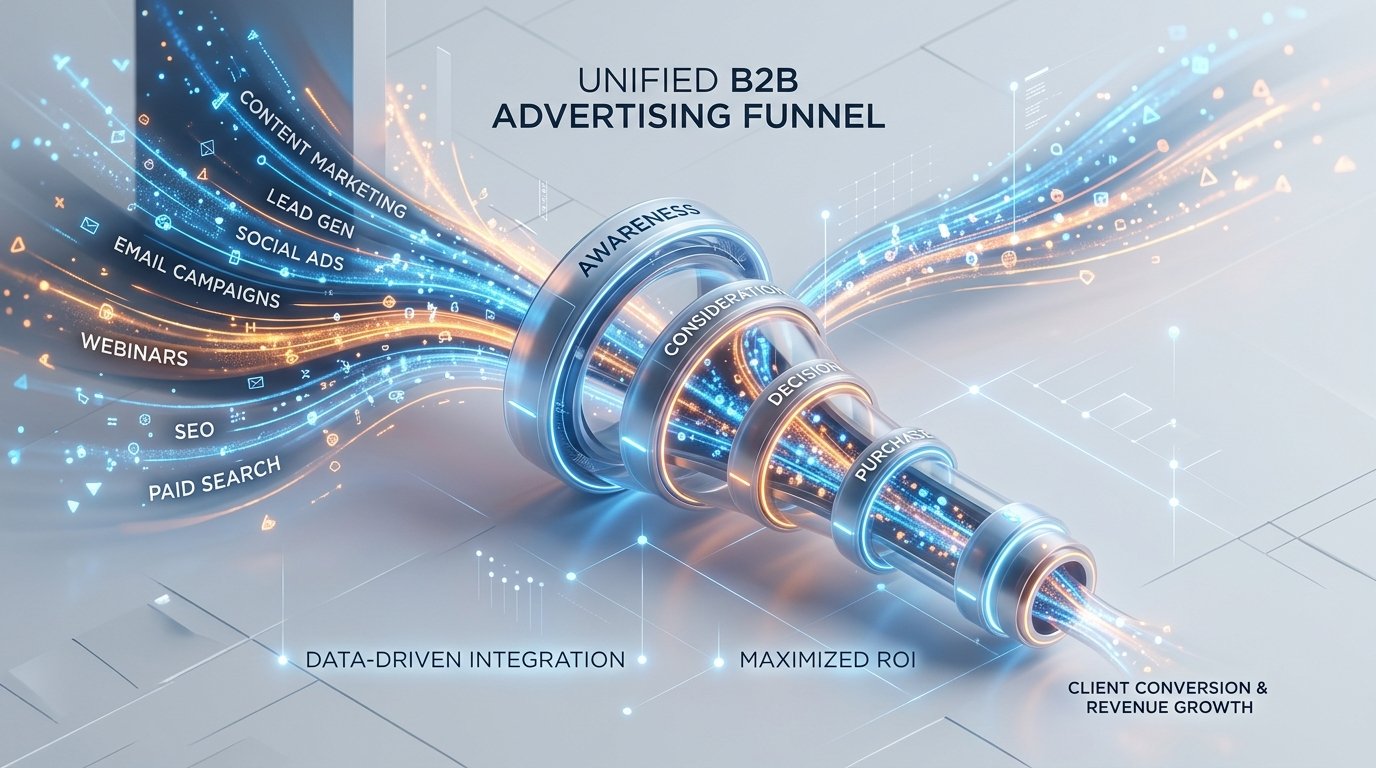
- Most B2B ad strategies fail by treating paid social, search, and display as separate channels, not one funnel.
- A documented strategy cuts wasted spend in month one and offers a baseline to build on.
When “post and pray” is your entire strategy
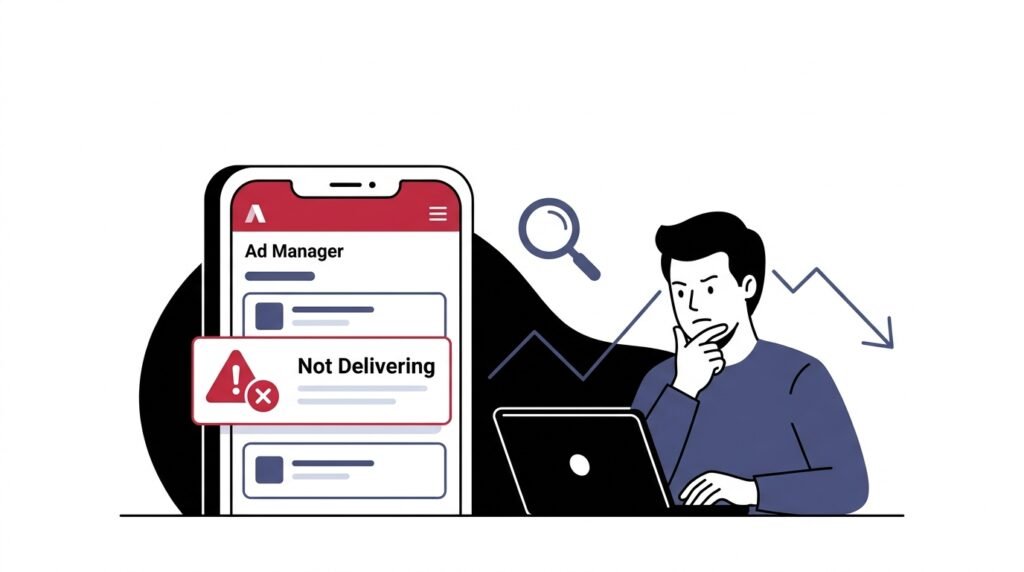
Picture this: a B2B SaaS company running Facebook ads, Google Search campaigns, and LinkedIn Sponsored Content at the same time. Three different agencies. Three separate briefs. No shared ICP definition. No agreed funnel stage for any campaign. The Google team tracks clicks as the main metric. The LinkedIn team reports impressions. Facebook reports reach.
At Gwenchana Digital, we audited a client running exactly this setup. They were spending $8,000 per month across three platforms with no strategy document connecting the work. No consistent message. No shared definition of what a qualified lead looked like. When we asked which channel was working, nobody could give a clear answer because attribution wasn’t configured the same way across any of them.
We consolidated to two channels, aligned creative to funnel stage, and locked in a shared ICP definition before touching anything else. Cost per qualified lead dropped 40% within 60 days.
That improvement didn’t come from better targeting or smarter copy. It came from stopping three uncoordinated campaigns from working against each other.
The problem is never the channel list. It’s the absence of something connecting the decisions.
What a B2B advertising strategy actually contains
A B2B advertising strategy is a documented plan that connects your ICP to the right channels, funnel stages, and pipeline metrics. It defines who to target, where to find them, what to say at each stage, and how to know whether the spend is generating pipeline.
This is not a media plan or a budget allocation table. A strategy is the document that justifies every campaign decision before money moves.
A complete B2B advertising strategy has six components:
- ICP definition: who you’re targeting, specific enough to drive channel and message decisions
- Channel selection rationale: which platforms you’ve chosen and why, grounded in where your ICP actually pays attention
- Funnel stage mapping: what creative and content fits awareness, consideration, and conversion
- Creative brief: the message architecture per campaign; problem, proof points, and CTA that stay consistent across channels
- Measurement framework: the pipeline metrics you’ll track, not the vanity metrics platform dashboards surface by default
- Optimization cadence: when you review performance, what decisions that review can trigger, and who owns the call
Most B2B advertisers have some version of components two and five in place. ICP definition and funnel stage mapping are where the gaps consistently appear.
ICP-first: the decision that determines everything else
An ICP (ideal customer profile) is a description of the company type and buyer role most likely to become a high-value, long-term customer. It includes firmographic data (industry, company size, revenue range), technographic context (what tools they already use), and behavioral indicators (how they buy and who signs off).
Your ICP is not a persona. A persona describes an individual. Your ICP describes the type of company and the specific buyer inside it that your paid campaigns are actually trying to reach.
Here’s why ICP specificity drives every downstream decision. Say your ICP is an IT Manager at a mid-market SaaS company with 200 to 500 employees. That single description tells you:
- Platform: LinkedIn over Meta. Job-function targeting on LinkedIn isolates that role with precision Meta can’t match for B2B.
- Message stage: Problem-aware, not awareness. These buyers aren’t discovering that security matters; they’re comparing options.
- Content format: Case studies and ROI evidence, not brand storytelling.
- Creative direction: Specific, functional headlines. Not aspirational ones.
Change the ICP to a CMO at a 30-person startup and every one of those decisions shifts: different platform weight, different message stage, different creative register entirely.
The test for whether your ICP is specific enough: can someone on your team look at the definition and immediately eliminate at least one channel? If not, it needs narrowing.
Choosing channels based on where your ICP actually is
Channel selection is an ICP question, not a category question. The answer isn’t “LinkedIn for B2B, always.” It starts with the job title, maps to platform behavior, and factors in budget reality.
| ICP job title | Primary platform | Content format that works | Budget signal |
|---|---|---|---|
| C-Suite / VP (Enterprise) | Thought leadership, event-based content | Higher CPM; longer nurture period | |
| IT Manager / Director (Mid-market) | LinkedIn + Google Search | Case studies, problem-solving guides | Mid-range; test both in parallel |
| Marketing Manager / Growth (SMB) | Meta + LinkedIn | Product demos, social proof | Lower CPM on Meta; faster feedback cycle |
| Developer / Technical buyer | Google Search | Documentation, tutorials, free tools | Intent-based; search outperforms social |
| Procurement / Finance | LinkedIn + Google Display | ROI calculators, compliance content | Long nurture; low conversion volume |
Two things this table doesn’t resolve: whether your specific ICP uses these platforms the way the data suggests, and whether your current budget is enough to compete in those channels at meaningful volume. Start with a hypothesis grounded in audience behavior, then test. Scaling before you’ve validated targeting is how companies end up in the fragmented setup from the opening example.
For how B2B paid social advertising works across these channels in practice, that’s covered in detail separately.
Building the funnel: from awareness to conversion
The most expensive mistake in B2B advertising is running conversion-stage ads to audiences who have never encountered the brand. It happens because conversion campaigns are easy to attribute and leadership can see the direct line from spend to action. Awareness campaigns require patience and are harder to defend in a monthly report.
This framing is backwards. A cold audience that sees a “Book a demo” ad doesn’t book a demo. They scroll past.
Here’s how the funnel should work:
Awareness
Goal: get the right people to recognize that you exist and that you address a problem they actually have. You’re not selling here; you’re surfacing. Short-form video, educational content, and targeted display work at this stage.
The most common mistake: skipping it entirely because it’s hard to attribute directly to pipeline.
Consideration
Goal: move ICP-qualified audiences from “I’ve seen them around” to “I should look into this.” Retargeted case studies, comparison content, and specific landing pages belong here. The CTA shifts from “learn” to “evaluate.”
The most common mistake: sending consideration traffic to a generic homepage.
Conversion
Goal: turn active evaluators into pipeline. These are people who already know the brand and have engaged with consideration-stage content. Demo requests, consultation bookings, and free trials belong at this stage.
The most common mistake: running conversion campaigns to cold traffic because the retargeting pool is too small.
That last point connects back to everything upstream. If awareness and consideration campaigns aren’t running, your conversion retargeting audience stays thin and performance stays inconsistent. The three stages aren’t separate options to pick between. They’re a sequence.
How to measure whether your strategy is working
Stop using impressions, CTR, and platform-reported ROAS as your primary success metrics. These show how individual ads are performing. They don’t show whether the strategy is generating pipeline.
Three metrics that do:
Cost per qualified lead (CPQL): Total ad spend divided by the number of leads that meet your ICP definition and pass to sales. Not all leads. Qualified leads. The definition of “qualified” must be agreed on before campaigns launch, or this number becomes meaningless.
Lead-to-opportunity rate (L2O): The percentage of qualified leads that sales converts to an active opportunity. A consistently low L2O rate usually means one of two things: the targeting is attracting the wrong ICP, or sales and marketing are working from different definitions of “qualified.”
Influenced revenue:
Influenced revenue is revenue from deals where advertising touchpoints appeared in the buyer’s journey, even when advertising wasn’t the direct conversion source. It captures pipeline impact that last-click attribution misses entirely.
According to a 2024 survey by RevSure and Ascend2, only 31% of B2B marketers feel highly confident about the accuracy of their attribution data. Influenced revenue is how you measure impact without depending on attribution being perfect.
Tracking influenced revenue requires UTM parameters on all campaigns, a lead source field in your CRM, and a consistent handoff process where sales records which deals had prior marketing touchpoints. It’s setup work upfront. It’s also the only way to prove ROI past the first click.
In-house vs agency: an honest breakdown
Both models work. Which one fits depends on what internal capacity you actually have.
In-house works when you have at least one dedicated paid media strategist whose role isn’t split across content, social, and email simultaneously. You also need creative production capacity: a designer and copywriter who can turn briefs into campaign assets on a regular cadence. The advantage is depth of product knowledge that no external agency builds in month one. The disadvantage is time-to-competence. Building a team with real B2B advertising experience takes three to six months at minimum.
Agencies work when you need operational speed. A good B2B agency brings existing playbooks, platform experience, and a testing history you’d otherwise spend budget building from scratch. The disadvantage: agencies run multiple client accounts, and unless you’re a meaningful account by size, their strongest strategist won’t be on your work every week.
The practical reality: if you’re rebuilding from scratch with a marketing team of fewer than five people, external support for the first six to twelve months usually makes sense. If you have a capable in-house strategist, keep ownership internal and bring in an agency for specific gaps such as creative production, attribution setup, or account-based marketing programs.
If you’re evaluating external partners, our guide on how to choose a B2B marketing agency covers what to look for and where most hiring decisions go wrong.
At Gwenchana Digital, we have audited B2B advertising setups for companies across Indonesia and Southeast Asia, from startups running their first paid campaigns to enterprise teams rebuilding after years of disconnected channel decisions. The fragmentation pattern from the opening section is not an edge case. It is the default. The six-component structure in this guide is what we use as the diagnostic baseline before making any paid campaign recommendation through our Digital Advertising service.
Frequently asked questions
What should a B2B advertising strategy include?
A B2B advertising strategy should include six components: an ICP definition, channel selection rationale, funnel stage mapping, a creative brief, a measurement framework tracking pipeline metrics, and an optimization cadence. Without all six in place, you have a collection of campaigns. Not a strategy.
How much should a B2B company spend on advertising?
Most B2B companies allocate between 2% and 10% of target revenue to paid advertising, with higher allocations at earlier growth stages when brand awareness is low. A more practical starting point: budget enough per channel to generate statistically useful data before drawing conclusions. On most platforms, that typically means $2,000 to $5,000 per month per channel, though this varies by industry and audience size. Validate one or two channels before scaling spend.
What’s the difference between B2B and B2C advertising strategy?
B2B advertising targets a buying committee, not a single consumer. Sales cycles run longer (weeks to months rather than hours to days), purchase decisions carry higher value and lower frequency, and multiple stakeholders with different priorities must be reached. This changes channel selection (LinkedIn outperforms Meta for most B2B ICPs), creative approach (educational and proof-based rather than emotional or lifestyle-driven), and what you measure (pipeline metrics rather than purchase events).
How do you measure B2B advertising effectiveness?
Measure using pipeline metrics: cost per qualified lead, lead-to-opportunity rate, and influenced revenue. These connect spend to actual sales outcomes. Platform-reported metrics such as CTR, reach, and ROAS tell you how individual ads are performing; they don’t tell you whether the strategy is generating pipeline.
Should I build B2B advertising in-house or hire an agency?
Build in-house if you have a dedicated paid media strategist and creative production capacity already in place. Hire an agency if you need speed to competence, lack internal B2B advertising experience, or are rebuilding after inheriting a fragmented setup. Many B2B teams run both: in-house strategy ownership with agency support for execution, creative production, or specialized programs like account-based marketing.
A B2B advertising strategy that generates real pipeline doesn’t need more channels or a larger budget. It needs a defined ICP, mapped funnel stages, and a measurement setup that connects spend to actual pipeline impact rather than impressions.
If you’re not sure whether your current setup has all six components in place, or you’ve inherited a fragmented account and need a starting point, we offer a free strategy audit. Forty-five minutes. We’ll review your setup, tell you what’s working, identify the gaps, and say exactly what we’d change first.