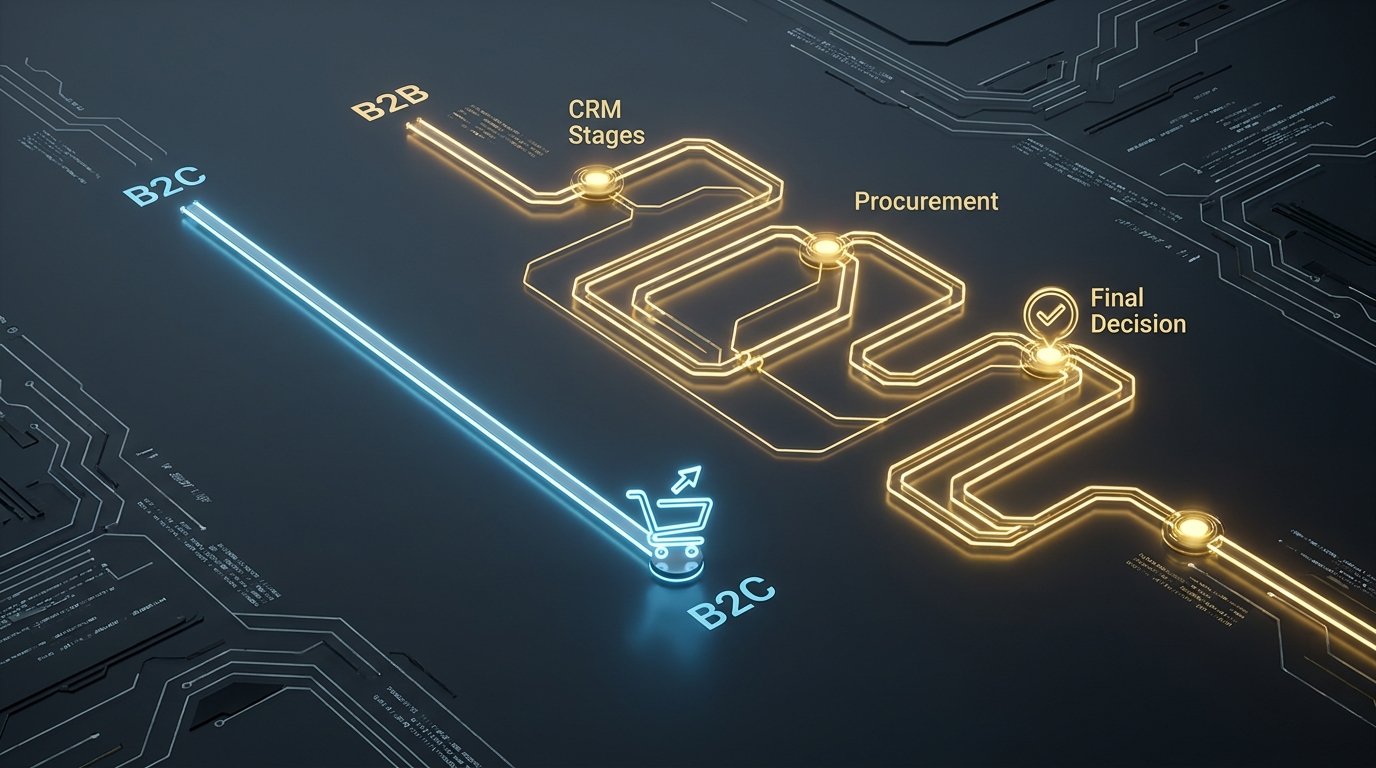

B2B retargeting ads work differently from B2C because the purchase timeline is completely different. At Gwenchana Digital, we help B2B companies across Southeast Asia build paid media systems that match their actual sales cycle — not platform defaults. One of the most consistently misconfigured elements we audit: retargeting windows that are too short and audiences that aren’t segmented by intent. A B2C buyer who visits a product page might convert within 48 hours. A B2B prospect researching your services might take 60 to 90 days to reach a buying decision. Standard 7-day or 30-day retargeting windows miss most of your pipeline. Effective B2B retargeting segments audiences by the page they visited, not just when they visited it, and matches window length to your actual sales cycle.
Why B2C retargeting logic breaks in B2B
The entire logic of standard retargeting is built on one assumption: if someone visited your site recently, they’re close to a decision. For B2C, that’s often true. A shopper who looked at a pair of sneakers yesterday is either going to buy them this week or move on. A 7-day retargeting window makes sense for that purchase behavior.
B2B doesn’t work that way. A marketing manager at a mid-sized company who reads your case study in January might not have budget approval until March. Their procurement team might need a vendor comparison. Their CTO wants a security review. The deal takes 60 days at the short end and can run to 90 days or more for enterprise accounts.
This is why standard ad logic fails in B2B contexts — the platform defaults were designed for retail intent signals, not considered B2B purchasing. Meta’s algorithm in particular optimizes toward quick conversion events. When you feed it a 7-day retargeting window for a B2B audience, it treats a cold homepage visitor from six weeks ago the same as someone who abandoned your contact form yesterday. Those are not the same prospect.
The fix isn’t a bigger budget. It’s a longer window and smarter segmentation. For most B2B advertisers, the minimum useful retargeting window starts at 30 days, and 60 to 90 days is appropriate for enterprise deals. The right number comes from your CRM’s average sales cycle length, not the platform default. If that data isn’t being tracked yet, understanding how Meta Ads work differently for B2B is a useful starting point before touching audience settings.
The three retargeting audiences that matter for B2B
Most B2B retargeting setups lump everyone who visited the website into a single audience. That’s roughly the same as sending the same sales email to a cold lead and someone who just requested a proposal. The page someone visited tells you far more about intent than the date they visited it.
These are the three segments worth building, with the window length and messaging approach that fits each one.
- Website visitors segmented by page type. A homepage visit means someone was curious enough to look. A pricing or services page visit means they’re actively evaluating options. A case study or results page visit means they’re building a business case internally. Each needs a different window and a different message. Homepage and blog visitors: 60 to 90 days, top-of-funnel thought leadership. Pricing and services page visitors: 45 to 60 days, social proof and client results. Case study readers: 60 days, content that reinforces trust and specificity in their industry.
- Video viewers and content engagers. Someone who watches 50% or more of a YouTube or LinkedIn video, or returns to your blog more than once, is in an active research phase. They haven’t raised their hand yet, but the behavioral pattern is distinct from a one-and-done visit. Window: 30 to 60 days. Messaging should move them toward a more concrete asset — a case study teaser, a data-backed insight, something that earns a second look rather than a direct pitch.
- Lead form partial completers. This is the highest-intent signal in your retargeting stack. Someone who started filling out a contact form and left is closer to a conversation than any other non-converting visitor. The most common reason for abandonment is friction, not disinterest. Window: 14 to 30 days. The creative doesn’t need to be subtle here. “Talk to a person, not a form” has worked consistently for this audience type. Keep the CTA direct and reduce the barrier to the next step.
For the full setup process on Meta, see the platform section below, or go deeper with B2B retargeting on Meta.
Audience segmentation is the layer we fix first in almost every retargeting audit at Gwenchana Digital — it’s where the most spend is being wasted, and where the fastest improvements tend to come from. If you want a quick read on where your current setup stands, the free audit starts here.
Retargeting by funnel stage — what creative to show
The most common creative mistake in B2B retargeting is running a bottom-funnel ad to the entire retargeting pool. Someone who visited your homepage once and immediately gets a “Book a demo” ad in their feed is seeing a mismatch — and it tends to burn frequency budget on people who aren’t ready for that conversation.
The table below maps creative type to the audience signal. B2B ad creative that works at each funnel stage covers the visual execution in more depth, but the logic starts here.
| Funnel stage | Audience signal | Creative type | CTA |
|---|---|---|---|
| Top-funnel | Homepage visit, blog read | Thought leadership content, case study teaser | “See how [industry] companies solved [problem]” |
| Mid-funnel | Pricing page, services page | Client result, testimonial, social proof | “See what clients say” |
| Bottom-funnel | Form abandon, 3+ page visits in one session | Direct offer, consultation framing | “Let’s talk — no deck required” |
One note on the bottom-funnel row: “3+ page visits in one session” is a stronger signal than a single pricing page visit. Build it as a separate audience rule using session-based behavior tracking in Ads Manager.
Platform-specific setup notes for B2B retargeting ads
The principles above apply across platforms. The mechanics differ enough between Meta and LinkedIn that they’re worth treating separately.
Meta
Meta’s custom audience builder is flexible enough for B2B segmentation, but the defaults aren’t configured for it. Here’s the setup sequence:
- In Audiences inside Meta Business Suite, create Website Traffic audiences using “URL contains” rules to separate segments:
/pricingand/servicesinto one audience,/case-studiesand/resultsinto another, all remaining URLs into a general visitor bucket. Apply window lengths per segment as described above. - Build exclusion audiences before running a single ad. Upload your existing client list as a Customer List audience and exclude it from every retargeting campaign. Create a separate exclusion for anyone who completed a lead event in the past 30 days. Cross-reference with your CRM if you have a leads integration active.
- Keep ad sets separate by audience segment — one segment per ad set. Combining segments removes your ability to control creative by intent level, which is the whole point of segmenting in the first place.
The Meta Ads for B2B guide covers the broader campaign architecture if you’re building from scratch. Note that the Conversions API setup is a separate configuration step that meaningfully improves attribution accuracy for longer sales cycles — Meta reads offline B2B conversion signals more accurately when CAPI is active alongside the pixel.
LinkedIn’s retargeting options split into two distinct approaches, and the choice between them changes the strategy:
- Website Retargeting uses the LinkedIn Insight Tag to build audiences from site visitors. This is the equivalent of Meta’s website custom audiences. Set it up in Campaign Manager under Matched Audiences, then apply the same URL-level segmentation logic.
- Contact Retargeting lets you upload a CRM list and target those individuals directly on LinkedIn. Better for account-based plays where you already have the decision-maker list.
- Company Retargeting targets anyone at a company whose domain you specify. Useful for awareness plays at target accounts before you have individual contact data, which is a common early stage in B2B enterprise pipeline building.
- Set frequency caps manually at the campaign level. LinkedIn’s defaults are generous. Four to five impressions per member per week is a workable ceiling for B2B retargeting. Exclude current clients using uploaded company or contact lists, the same approach as Meta.
For the campaign structure specific to the Indonesian and SEA B2B market, see LinkedIn Ads for B2B.
The frequency problem — how not to stalk your prospects
There’s a version of B2B retargeting that builds pipeline, and a version that annoys the exact people you’re trying to close. The difference usually comes down to frequency.
Here’s what ad fatigue looks like in the data before it shows up in performance reports: CTR drops week over week while impression share holds steady. If your retargeting audience is seeing your ad 12 times in 30 days and clicking less each week, the problem isn’t the creative. It’s saturation.
Practical frequency ceilings that hold up in B2B retargeting data: Meta at 3 to 4 exposures per person per week, LinkedIn at 4 to 5 per member per week. These aren’t platform recommendations — they’re the point at which CTR tends to stabilize before dropping off in B2B campaigns specifically.
Two fixes that work faster than adjusting frequency caps alone:
First, exclusion windows. When someone books a meeting, submits a form, or takes any high-intent action, remove them from the retargeting audience the same day. Don’t wait for the window to expire. Running bottom-funnel ads at someone who already raised their hand is wasted spend, and in a relationship-driven B2B sale, it signals disorganization.
Second, a practical internal test: if your own team is seeing your retargeting ads more than twice a day, your cap is too loose. Your team is inside your pixel audiences by default unless you explicitly exclude internal IP ranges or an employee contact list. It’s worth checking before diagnosing the problem elsewhere.
Measuring B2B retargeting ROI
This is where B2B attribution gets genuinely difficult, and where most reporting setups consistently undervalue retargeting’s contribution.
The core issue: B2B buyers rarely click a retargeting ad and convert in the same session. They see the ad on a Tuesday, recall the brand, then search your company name on Thursday and request a demo through organic. In a last-click attribution model, retargeting gets zero credit for that deal. Click-through attribution undercounts retargeting’s actual contribution by a meaningful margin when sales cycles stretch past 30 days.
A more reliable measurement approach uses three signals together: assisted conversions in Meta or LinkedIn attribution reports (set your window to 28 days click, 7 days view-through), view-through conversions specifically for people who saw the ad without clicking but converted within the window, and branded search volume during active retargeting periods. If branded search lifts when you run retargeting and drops when you pause it, that’s the mechanism working as intended even when direct clicks don’t show it.
On the question of ROAS: a single target number doesn’t work well for B2B retargeting because the conversion event is rarely a purchase. The more useful frame is cost per influenced pipeline opportunity — retargeting spend divided by the number of pipeline opportunities where retargeting appeared as an assisted touchpoint in your attribution data. For general B2B paid media context, Directive’s 2025 benchmark data shows average ROAS running at 2.6 for SaaS mid-market and 3.2 for enterprise tech across full campaigns. At Gwenchana Digital, we use those benchmarks as a baseline floor when scoping retargeting budgets for B2B clients in the SEA market — retargeting typically outperforms those averages when audiences are properly segmented, because you’re re-engaging people who already have some familiarity with the brand. On the cost-per-opportunity side, a 2025 B2B PPC analysis by The Digital Bloom puts LinkedIn’s cost per opportunity at around $340 versus Google’s $290, with LinkedIn delivering 4.2x pipeline revenue per dollar spent when deal values and win rates are factored in. Retargeting-specific figures don’t get published at that granularity, but Display and retargeting campaigns consistently generate the best cost per company influenced among Google’s ad products, according to 2025 B2B GTM benchmark data, because they capture existing buying intent rather than create it.
For the full attribution picture across B2B paid social, the B2B marketing attribution guide covers the multi-touch modeling that makes these numbers reliable.
Red flags worth recognizing: high frequency combined with low CTR and no assisted conversions points to creative fatigue or wrong audience segmentation. Rising branded search volume combined with strong view-through conversions and low direct click volume points to retargeting working as intended, just not the way last-click reports make it look.
If you want to see how your current retargeting attribution stacks up, the Gwenchana Digital free audit includes an attribution review as a standard line item — not a separate upsell.
Frequently asked questions about B2B retargeting ads
How long should B2B retargeting windows be? Most B2B retargeting windows should run 30 to 90 days, depending on your average sales cycle length. Homepage and general visitors: 60 to 90 days. High-intent visitors to pricing, services, or case study pages: 45 to 60 days. Lead form abandoners: 14 to 30 days. The right number comes from your CRM data, not platform defaults.
What’s the best platform for B2B retargeting ads? It depends on your audience and deal type. Meta reaches a broader audience at lower CPMs and works well for B2B businesses where decision-makers can be identified through behavioral signals. LinkedIn offers more precise company and job title targeting, which suits enterprise and ABM-style plays better, but at significantly higher cost per impression. Most B2B advertisers benefit from running both, with different segmentation approaches per platform.
How much should I spend on B2B retargeting ads? Retargeting audiences are small by nature, typically a fraction of your prospecting audience size. Among B2B SaaS companies, retargeting platforms typically receive 15 to 20% of the paid media allocation, sitting behind Google Ads and LinkedIn in overall share but ahead of most other channels. For companies in the growth stage specifically, Right Percent’s B2B ads data puts the most efficient range at 10 to 15% of the prospecting campaign budget rather than total paid media. Start at the lower end, monitor frequency before raising spend, and increase allocation only when audience size justifies it.
What creative works best for B2B retargeting? Creative performance depends on funnel position. Top-funnel retargeting responds to thought leadership and social proof — case study teasers, client result snippets. Mid-funnel benefits from specificity: testimonials from companies similar to the prospect, concrete outcome data. Bottom-funnel, especially form abandoners, responds to reduced friction — a direct offer to speak to a person rather than complete another form.
How do I stop my B2B retargeting ads from becoming annoying? Set frequency caps manually (3 to 4 per week on Meta, 4 to 5 on LinkedIn), exclude anyone who has already converted or taken a high-intent action from active retargeting immediately rather than waiting for the window to expire, and rotate creative every 3 to 4 weeks. A sustained drop in CTR alongside stable impression share is the clearest signal the creative has run its course.
How do I measure ROI on B2B retargeting campaigns? Avoid relying on click-through attribution alone — it undercounts retargeting’s impact in longer sales cycles. Use assisted conversions with a 28-day click and 7-day view-through window, track branded search volume during active retargeting periods as a recall proxy, and connect retargeting touchpoints to CRM pipeline data to calculate cost per influenced pipeline opportunity rather than cost per click.