
The “Meta is for B2C” argument gets repeated so often it starts to feel like fact. If you’ve been skeptical about running meta ads for B2B, or if you ran them once and got poor results, this is worth reading before you write the platform off entirely.
Meta ads can work for B2B, but the outcome depends almost entirely on your ICP and how the campaign is structured — not on the platform itself. For certain B2B profiles, particularly SMB-focused products and professional services targeting business owners, Meta consistently delivers qualified leads at significantly lower CPL than LinkedIn. For enterprise B2B with complex targeting requirements, it usually doesn’t.
The “Meta is B2C” myth and where it actually comes from
The argument goes like this: LinkedIn has professional context, Meta doesn’t, so LinkedIn is the right place for B2B. That logic isn’t wrong. It’s just incomplete.
B2B decision-makers are people. CMOs, IT Directors, and CFOs use Instagram and Facebook. They scroll during their commute, check in after dinner, and watch videos between meetings. The difference is that they’re not in “buying mode” when they do — and that changes how you reach them, not whether you can.
If you want to understand what Meta ads actually are before the myth took hold, the foundational mechanics haven’t changed. What has changed is the platform’s ability to find the right people.
Part of why the skepticism stuck is that it was, for a period, justified. After Apple’s App Tracking Transparency update in 2021, Meta lost a significant portion of its behavioral signal. Campaigns that ran in 2022 and early 2023 suffered from audience imprecision that genuinely hurt B2B performance. At Gwenchana, we saw this firsthand with clients who tried Meta in that window, got thin results, and concluded the platform didn’t work for B2B. The conclusion was understandable. The problem is most of them haven’t updated it since.
Meta responded with two things: the Conversions API (CAPI), which routes conversion data server-side and bypasses browser-level signal loss, and Advantage+ audiences, which use AI-driven optimization to find buyers with far less manual targeting input. The platform in 2026 is not the platform from 2022. Campaigns that struggled then are producing different results now.
Where Meta actually wins for B2B
Meta’s role in B2B is demand generation, not demand capture. It reaches buyers before they’re actively searching for a solution. For the right ICP, that’s a genuine advantage — and clarity on that role is what most failed B2B Meta strategies are missing. For how Meta fits into a broader B2B paid social strategy, channel positioning matters as much as targeting.
Five B2B ICP profiles where Meta outperforms LinkedIn as a primary or co-primary channel:
SMB-focused SaaS products. The decision-maker at a 10-person company is also the person running their Instagram. They don’t draw a hard line between professional and personal browsing. Lower deal complexity means Meta’s CPL advantage over LinkedIn is directly meaningful to the budget.
Professional services targeting business owners. Accountants, consultants, recruiters, and financial advisors who sell to business owners find Meta unusually effective because their buyers behave like consumers on the platform. LinkedIn’s job-title targeting often misses owners who list themselves by business name rather than by role.
E-commerce enablement tools. Products sold to people who run online stores. These buyers spend significant time on Meta for their own business advertising, which makes behavioral targeting precise without requiring explicit professional data.
Event promotion and webinar registration. Meta’s event-objective campaigns and retargeting windows routinely outperform LinkedIn for driving registrations at lower cost, especially for awareness-stage events where the audience is broad.
B2B retargeting, regardless of ICP. This is close to a universal win case. Meta’s pixel-based retargeting of website visitors is almost always cheaper than LinkedIn retargeting for the same audience. If someone has already been to your pricing page, Meta is a cost-efficient way to stay in front of them.
For a deeper look at Meta’s role specifically as a B2B lead generation channel, the structural approach differs meaningfully from B2C lead gen.
Where Meta loses to LinkedIn
LinkedIn Ads for B2B has a targeting capability Meta genuinely cannot match in three situations: when you need to reach specific job titles at named enterprise accounts, when the professional context of the ad placement matters to the buyer, and when your industry carries enough regulatory weight that platform credibility is part of the trust equation.
We’re straightforward about this with every client. Recommending Meta when LinkedIn is the right fit doesn’t serve anyone.
| Meta is the stronger choice when… | LinkedIn is the stronger choice when… |
|---|---|
| ICP is SMB owners, startup founders, or business operators | ICP requires senior enterprise titles (VP, C-suite) at companies with 500+ employees |
| Deal size is under $10K with a short sales cycle | Deal size is $50K+ and involves multiple stakeholders across a 3+ month cycle |
| Goal is awareness or retargeting existing website visitors | Goal is cold outreach to exact job functions at named accounts (ABM) |
| Budget is limited and CPL efficiency matters most | Professional context of the ad placement matters to the buyer |
| First-party data is available for lookalike building | Industry is regulated (finance, healthcare, legal) where platform credibility carries weight |
The mindset difference is real and worth taking seriously. A CFO who sees a finance software ad while scrolling LinkedIn is in a different frame of mind than the same CFO seeing the same ad while watching a video. That’s not irrational buyer behavior — it’s how attention works. For high-consideration enterprise B2B, that context gap is a genuine limitation of Meta, not just a targeting problem.
Why most B2B Meta campaigns fail
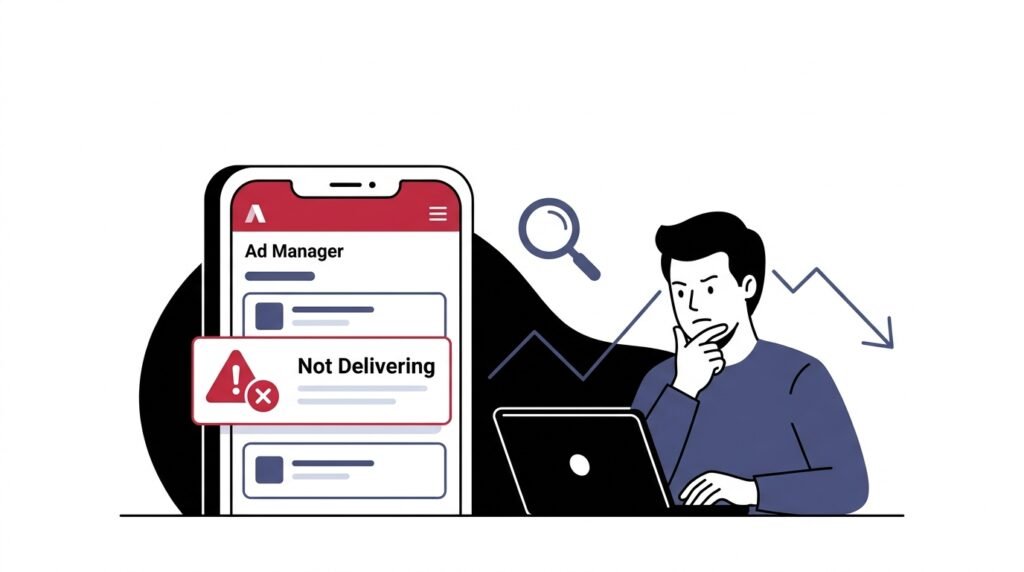
The failure rate on B2B Meta campaigns is high. The platform gets blamed. In most cases, the problem is one of four structural mistakes — and knowing why B2B ads fail to generate leads before you launch is considerably cheaper than learning it from a failed campaign.
Audience too broad for the ICP. B2B marketers set up interest-based targeting with audience sizes of two to three million users. Meta’s algorithm has no signal to work with, so it optimizes toward the cheapest engagement, not the right buyer. The fix is to start with first-party data: upload your customer email list, build a lookalike from your best accounts, or use tight behavioral signals before scaling outward.
B2C creative on a B2B offer. Product image, generic headline, link to homepage. This is how B2C ecommerce ads work. B2B buyers need to understand the problem being solved before they care about the solution. An ad that leads with a pain point the buyer recognizes performs differently from an ad that leads with a product feature. Most agencies carry over their consumer playbook without adjusting it for B2B — and the results show.
Wrong offer for the funnel stage. Sending cold audiences directly to a “Book a Demo” CTA. Cold audiences on Meta are not ready to buy. The offer for cold traffic should be low-commitment: a diagnostic tool, a short video that frames a specific problem, a research report. Demo requests belong in retargeting, not the first touchpoint.
No retargeting layer. Running only top-of-funnel campaigns and measuring results on direct conversion. Meta’s B2B strength is built in the retargeting layer. Warm audiences who visited your site, watched 50% of a video, or opened a lead form convert at rates that justify the channel. Without this layer, you’re spending to create awareness with no mechanism to convert it. The Offline Conversions API is part of what makes the retargeting signal accurate enough to matter.
What a B2B Meta campaign actually looks like
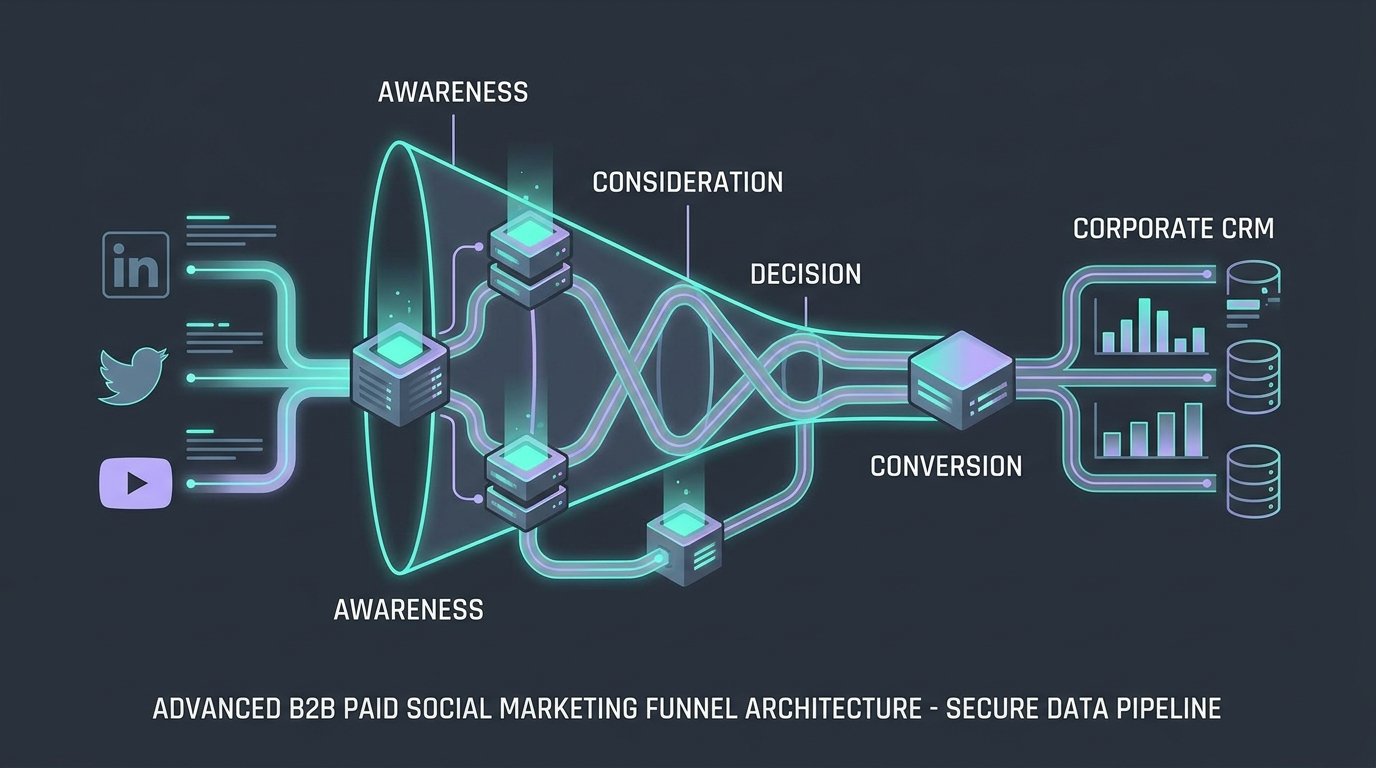
A B2B Meta campaign that works runs three stages in sequence. The creative principles behind each stage are worth a separate read — which is why the Meta Ads creative for B2B article exists. This section covers the funnel architecture.
For the full structural logic behind this approach, see the Meta Ads funnel architecture for B2B.
Stage 1 — Cold audience: problem-aware content. Audience: interest targeting, Business Decision Maker segments, or lookalikes built from your best customers. Objective: Awareness or Traffic. Offer: content that names a problem your ICP already recognizes — not a product pitch. Success metric at this stage is video view rate or content engagement, not lead volume. Budget allocation: 50-60% of total campaign spend.
Stage 2 — Warm retargeting: social proof and credibility. Audience: website visitors in the 90-day window, video viewers at 50% completion or higher, lead form openers who didn’t submit. Objective: Lead Generation or Traffic to a landing page. Offer: a case study, a customer story, or a low-friction lead magnet. This is where B2B retargeting on Meta does its heaviest lifting. Budget allocation: 25-30%.
Stage 3 — Hot retargeting: direct offer. Audience: high-intent visitors (pricing page, demo page), previous lead form completions that didn’t convert. Objective: Conversions or Lead Generation. Offer: demo, consultation, or trial. The metric that matters here is cost per qualified lead (CPQL), not raw CPL. A cheap lead that never converts to an MQL is worse than an expensive one that does. Budget allocation: 15-20%.
How to decide if Meta is right for your B2B campaign
The question isn’t whether Meta works for B2B in general. It works for some B2B profiles and doesn’t for others. Four variables determine which side of that line you’re on: ICP seniority, deal size, available first-party data, and budget. The table below gives you a clear starting point.
| Your situation | Recommendation |
|---|---|
| ICP is senior decision-makers at enterprise companies (500+ employees) | LinkedIn as primary channel. Meta as retargeting support only. |
| ICP is SMB owners, startup founders, or business operators | Meta is viable as a primary channel. Test cold plus retargeting structure. |
| Average deal size under $10K with a short sales cycle | Meta’s CPL advantage is material. Worth testing as primary channel. |
| Average deal size $50K+ with a 3+ month sales cycle | LinkedIn for cold. Meta for retargeting and nurture only. |
| First-party data available (customer email list, strong pixel history) | Meta performance improves significantly. Prioritize it over cold interest targeting. |
| Budget under $3K/month for paid social | Meta stretches further. LinkedIn’s learning phase costs make it harder to justify at this scale. |
| Highly regulated industry (finance, healthcare, legal compliance) | LinkedIn’s professional context carries more weight. Meta secondary at best. |
If two or more of the LinkedIn-recommended conditions apply to your situation, LinkedIn should be your primary channel. Meta can still contribute as a retargeting or nurture layer in almost every case. For a structured review of how this applies to your specific setup, see our paid social audit for B2B brands.
Frequently asked questions
Do Meta ads work for B2B? They work for specific B2B profiles. SMB-focused products, professional services targeting business owners, and B2B brands with strong retargeting audiences tend to see good results. Enterprise B2B with complex, job-title-specific targeting requirements generally performs better on LinkedIn. The platform works. The fit depends on your ICP.
Should B2B companies use Facebook or LinkedIn ads? Most B2B companies should test both with separate objectives. LinkedIn is stronger for cold outreach to enterprise buyers by job title and company size. Meta is stronger for retargeting, awareness campaigns, and reaching SMB decision-makers who behave like consumers on social. The channels serve different parts of the funnel and are not direct substitutes.
What is the average CPL for B2B Meta ads? It varies significantly by industry, offer type, and lead qualification level. Cross-industry Meta CPL averaged around $27.66 in 2025, but that number is misleading for B2B. For B2B SaaS, raw lead CPL averages $63.40 — qualified leads (MQLs/SQLs) cost $150 to $250, and enterprise-level qualified leads can reach $350 to $550. Professional services firms typically see $25 to $70 per raw lead on Meta. The more useful metric is cost per qualified lead (CPQL): a $63 lead that converts at 2% costs more per sale than a $150 lead that converts at 15%. (Source: Involve Digital / AdAmigo Meta CPL Benchmarks 2025-2026)
How do you target B2B decision-makers on Meta? Start with first-party data: upload your customer email list and build a lookalike audience. Layer in Meta’s Business Decision Maker segments for cold audiences. Use website retargeting via the Meta Pixel and Conversions API (CAPI) to reach people who’ve already shown interest. Avoid relying on interest targeting alone for B2B — it produces audiences too broad to optimize toward the right buyer.
Why do most B2B Meta ad campaigns fail? Four reasons account for most failures: audiences too broad for the ICP, B2C-style creative applied to a B2B offer, demo CTAs sent to cold audiences who aren’t ready, and campaigns without a retargeting layer. The platform is not the problem in most cases. The structure is.
What types of B2B companies get the best results from Meta ads? SMB-focused SaaS products, professional services firms targeting business owners, e-commerce tool providers, and any B2B brand with a solid retargeting audience built from existing website traffic. Companies with available first-party data — customer lists, pixel history — see disproportionately better results because Meta’s optimization has real signal to work with.
Gwenchana has run meta ads for B2B clients across five industries. Tell us about your ICP and we’ll tell you honestly whether Meta makes sense for you — or whether your budget is better spent elsewhere. Book a free consultation — no pitch, no obligation.