

How do Facebook ads work? Through a real-time auction. Advertisers set a budget and audience, and Meta’s algorithm scores every eligible ad on bid, estimated action rate, and ad quality, combined into a total value score. The highest-scoring ad wins the placement, not necessarily the highest bidder.
This article covers the full mechanism: how the auction scores every ad, what happens during the learning phase right after launch, how Ads Manager’s campaign, ad set, and ad levels fit together, what a first campaign actually costs, and whether running ads solo or handing them to a managed service makes more sense. The budget numbers and the FAQ near the end answer the questions most guides skip, so it’s worth reading through to the finish.
What is Facebook advertising?
Facebook advertising is a paid system that lets businesses show image, video, or carousel content to specific audiences across Facebook, Instagram, Messenger, and Meta’s partner network. Unlike a regular post, an ad only reaches people once an advertiser pays to place it in front of a chosen audience, defined by demographics, interests, behavior, or prior interaction with the business.
Every campaign is built inside Meta Ads Manager, the single dashboard for setting objectives, budgets, audiences, and creative. The system doesn’t place ads randomly. It runs a live auction for every available ad slot, weighing each eligible ad’s bid against how likely it is to earn a response and how well people have rated it in the past. That auction, not manual placement, determines who sees what.
How do Facebook ads work? Inside the auction
Every time someone opens Facebook, Meta runs thousands of micro-auctions to decide which ads appear in that person’s feed. An ad enters the auction the moment its targeting matches the viewer. From there, three inputs decide whether it wins.
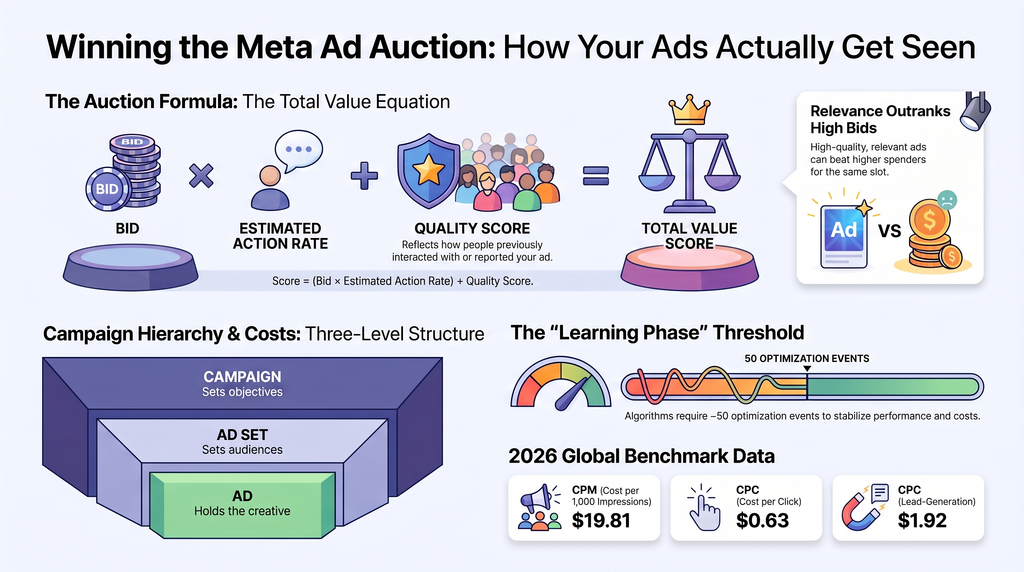
According to Meta’s own explanation of how it delivers ads, the total value score is the combined score used to rank competing ads. It has three parts:
- Bid: what the advertiser is willing to pay for the outcome they chose, whether that’s a click, a purchase, or a lead
- Estimated action rate: Meta’s prediction of how likely that specific person is to take that action, based on their behavior on and off the platform
- Quality score: how people have responded to the ad before, whether they hid it, reported it, or engaged with it
The three combine as bid multiplied by estimated action rate, plus the quality score.
A worked example: bid vs. quality score
Two advertisers are competing for the same slot. Advertiser A bids $5 per click but has a mediocre quality score and a low predicted action rate. Advertiser B bids $2 per click, and Meta predicts a much higher chance that this specific viewer will act, paired with a strong quality score. B’s total value score comes out higher, so B’s ad wins the slot at less than half of what A was willing to pay.
Why the highest bidder doesn’t always win
This is the part most beginner explanations skip. Facebook’s auction isn’t a silent bidding war where money wins outright. A well-targeted ad with a modest budget can consistently beat a high-spend ad that’s poorly matched to its audience. That’s also why two businesses with identical budgets can get wildly different results. The algorithm rewards relevance, not just spend.
The learning phase: what happens after you launch
The learning phase is the period right after you launch or significantly edit an ad set, when Meta’s algorithm is still gathering data on how your specific audience responds. It typically lasts three to seven days, or until the ad set records around 50 optimization events (purchases, leads, whichever the campaign is built around), whichever comes first.
Performance during this window is usually unstable. Cost per result can swing higher or lower day to day as the system tests different subsets of the audience. Pausing an ad set, changing the budget by a large margin, or editing the audience mid-phase resets the learning process and restarts the volatility.
Most of the wasted budget beginners blame on “the algorithm not working” actually comes from restarting the learning phase repeatedly instead of letting it settle. Judging a campaign from its first three days is premature almost every time.
Meta Ads Manager structure: campaign, ad set, ad
Every campaign is built on a three-level hierarchy inside Ads Manager. Understanding it prevents a common beginner mistake: editing the wrong level and resetting results across an entire campaign by accident.
| Level | What it controls |
| Campaign | The overall objective (traffic, leads, sales, awareness, app installs) and the buying type. Most advertisers use auction buying, which lets Meta optimize delivery automatically. A campaign can hold multiple ad sets. |
| Ad set | Audience (demographics, interests, custom or lookalike audiences, meaning people who resemble an existing customer list), placement (Feed, Stories, Reels, Messenger), budget, and schedule. Every ad in the same ad set shares these settings. |
| Ad | The creative itself: image or video, headline, copy, call-to-action button, and which Page or Instagram account represents the business. An ad set can contain several ads to test creative variations. |
The hierarchy matters for testing. Say a business wants to compare two audiences, ages 18 to 30 versus 31 to 50, under one traffic objective. That’s one campaign, two ad sets, each with its own ads. Because the split happens at the ad set level, only the audience variable changes.
Setting up your first Facebook ad, step by step
Setting up a first ad takes about fifteen minutes once the sequence is familiar.
- Choose a campaign objective. Pick the outcome that matches the actual goal, whether that’s traffic, leads, engagement, or sales, since this determines what Meta optimizes for internally.
- Name the campaign and set the buying type. Auction is the default and the right choice for almost anyone starting out.
- Build the ad set. Set a daily or lifetime budget, choose an audience (start broad rather than over-narrowing), and pick placements. Advantage+ placements, which let Meta distribute the ad automatically across Feed, Stories, and Reels instead of restricting it manually, usually outperform manual placement.
- Set the schedule. Decide whether the ad runs continuously or within a fixed date range.
- Build the ad itself. Upload the image or video, write the primary text and headline, and choose a call-to-action button that matches the objective.
- Install the Meta Pixel before publishing, if it isn’t already active. Without it, Meta has no data to learn from, and the algorithm can’t identify who’s likely to convert. Installing the Facebook Pixel is worth doing before the first ad goes live, not after. Once it is collecting data, how to create retargeting ads on Facebook shows how to turn that data into custom audiences.
- Review and publish. The ad enters Meta’s review process, and most reviews clear within 24 hours, though high-volume periods can take longer.
For a placement-specific walkthrough, see how to run Instagram ads. B2B advertisers comparing platforms may also want Meta Ads for B2B. If an ad account was created by mistake or is no longer needed, here is how to delete a Facebook ad account.
Free Account Check
Just set up your first campaign?
The steps above cover the mechanics. Whether the account is actually delivering efficiently is a separate question, one a quick outside review usually answers faster than a week of guessing.
Get a Free Ads AuditWhat does it actually cost? CPM, budget thresholds, and ROI
Cost is the question most beginner guides dodge. Here is what 2026 benchmark data actually shows:
- Global median CPM (cost per 1,000 impressions), per Triple Whale’s 2026 benchmark report: about $19.81, ranging from roughly $2.40 in manufacturing to over $42 in IT services
- Average CPC across all industries, per Roaspy’s 2026 benchmark data: close to $0.63
- Average CPC for lead-generation campaigns: closer to $1.92, since that action is worth more to the advertiser
Industry matters more than any single average figure.
Is $10 a day enough?
Yes, for testing, not for scaling. A $10 daily budget can validate whether an audience and creative combination gets a reasonable cost per click, especially in lower-CPM industries. It’s rarely enough to exit the learning phase quickly or run more than one or two ad variations at once. Businesses in competitive, high-CPM categories will likely need a larger daily budget just to gather enough data for the algorithm to optimize against.
What’s a good CPM/ROAS benchmark?
There’s no universal “good” number. Benchmark reports disagree by a wide margin depending on methodology and industry mix. A more useful target than any external benchmark is a business’s own break-even ROAS, the return needed just to cover the ad cost plus the cost of goods. Anything sustainably above that line is working. Anything below it isn’t, regardless of what an industry report calls “average.”
DIY vs. managed: running ads yourself vs. hiring help
Both paths can work. The right one depends on how much time, and how much room for costly trial and error, a business actually has.
| Running it yourself | Hiring a managed service | |
| Time investment | Several hours a week, especially during the learning phase | Minimal, reporting and check-ins only |
| Learning curve | Weeks to months to read auction data correctly | None, comes with existing campaign experience |
| Cost | Ad spend only | Ad spend plus management fee |
| Risk of wasted budget | Higher, especially in the first one to two months | Lower, mistakes get caught against daily campaign patterns |
| Best fit | Small budgets, single-product businesses, hands-on founders | Growing budgets, multiple campaigns, teams without ads bandwidth |
Neither path is inherently better. A founder with five hours a week and patience for the learning phase can run profitable ads alone. What tips the decision is usually the cost of a mistake: a $10-a-day test failing is a minor loss, but a large daily budget running on guesswork compounds that same mistake every day it stays live.
The gap between the two options rarely shows up in month one, since early-stage accounts of any kind look similar while still in the learning phase. It tends to show up by month three, when a self-managed account is often still fighting the same creative fatigue and audience overlap an experienced manager would have caught weeks earlier. For a closer look at this trade-off in a B2B context, see the in-house vs. agency dilemma.
Understanding how Facebook ads work, the auction, the learning phase, and Ads Manager’s structure, explains why results turn out the way they do. It doesn’t tell you whether a specific account is actually performing well. Two businesses can follow every step in this guide and land on very different results, because delivery, budget pacing, and creative fatigue are account-specific problems a generic guide can’t diagnose.
Managed Option
Considering the managed route?
Gwenchana’s Digital Advertising Services runs Meta Ads campaigns as a managed service, structured in tiers from a single-channel starter plan up to a full-funnel strategy across Meta, Google, and TikTok.
Talk to a Strategist