
A B2B video ad works when the first frame is about the buyer’s problem, not the company’s logo. Three seconds is all you get — B2B buyers scroll past weak hooks at exactly the same speed as everyone else. Format and length follow from funnel stage: a 15-second awareness hook and a 90-second case study are built for different buyers at different moments in the decision process, and treating them as interchangeable wastes budget at both ends.
At Gwenchana Digital, we’ve built briefs for B2B video campaigns across LinkedIn, Meta, and YouTube, and the failure pattern is consistent: most underperforming ads open on the brand, not the problem. The fix starts before the shoot, at the brief.
Why most B2B video ads don’t work
The diagnosis is usually the same. Watch enough B2B video ads — or commission enough of them — and the pattern becomes predictable. The first frame is a logo. The voiceover sounds like it was recorded by someone reading from a compliance document. By the 15-second mark, the ad has mentioned the company’s name three times and the viewer’s problem zero times.
There’s a structural reason this keeps happening. B2B video briefs often get written to satisfy internal stakeholders, not external viewers. The marketing manager wants the product features in. The CEO wants the company history in. The sales team wants the differentiators in. The result: a 60-second ad trying to do five things, which means it does none of them well.
Three failure patterns repeat across almost every underperforming B2B video. First, the logo-first opening: it uses the hook window — the 3 seconds where you either earn attention or lose it — to show something the viewer has no reason to care about yet. Second, the narration problem: a voiceover that sounds detached, scripted, or overly formal kills credibility faster than poor lighting ever could. Third, message overload: when a video tries to explain the company, the product, the differentiator, and the CTA in 60 seconds, none of it registers.
The fix starts before production, at the brief stage. For a strategic look at where B2B ad spend typically breaks down, see why B2B ads fail to deliver results. And if you want contrast — what the opposite looks like when the brief is built around the buyer’s problem — B2B ad examples that actually worked shows the difference clearly.
The 3-second rule — and why B2B buyers skip just as fast
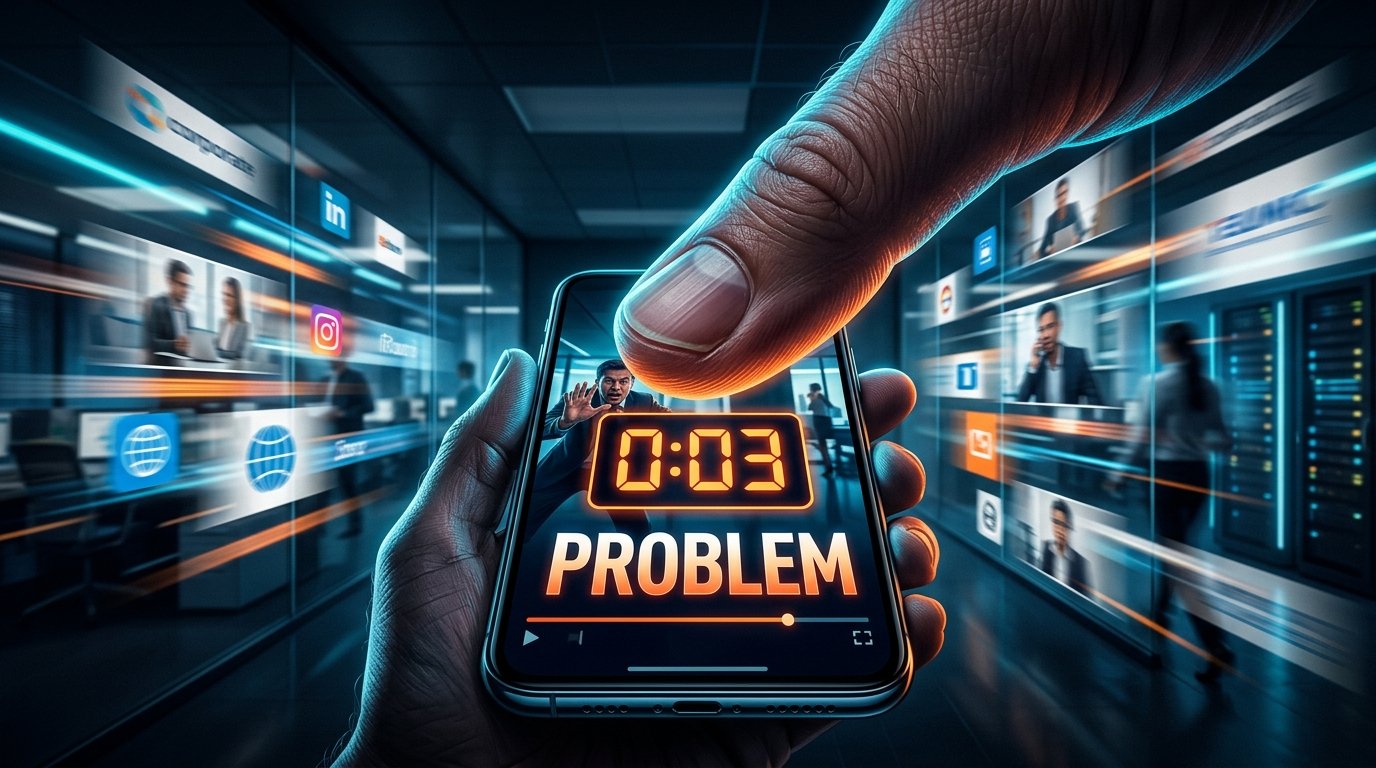
Call it what it is: the 3-second rule. On LinkedIn, on YouTube pre-roll, on Meta — video auto-plays muted and the viewer’s thumb is already moving. The decision to keep watching happens in the first three seconds, and it has nothing to do with whether you’re selling enterprise software or consumer running shoes.
B2B marketers often assume that a longer, more considered purchase earns them a more patient viewer. It doesn’t. The scroll behavior is identical. Your buyer might spend three months evaluating a vendor, but they’ll decide whether to watch your video in the same three seconds as everyone else.
What needs to happen in that window: the first frame must show the problem, not the solution. A viewer who recognizes their own situation in the opening image or headline keeps watching. A viewer who sees a company logo or a generic office stock photo does not.
View-through rate (VTR) — the share of people who watch a meaningful portion of your video — is the metric most directly controlled by how strong that hook is. On LinkedIn, the median VTR sits at 39.5% (source: Zenabm, 2026). The average-performing video loses 60% of its audience before it’s said anything substantive. A weak hook makes that number worse. There is no editing fix for a bad first frame.
B2B video ad formats by funnel stage
Not every video should do the same job. A 15-second awareness ad and a 90-second case study are built for different buyers at different stages. Using one format across all three funnel stages is one of the more expensive paid media mistakes — it wastes budget sending the wrong message at the wrong moment.
For a full picture of how video fits into a broader B2B paid social program, see the B2B paid social advertising guide. If you’re thinking about the funnel architecture first — how awareness connects to consideration and conversion — the Meta Ads funnel architecture walks through the structure in detail.
| Funnel stage | Format | Length | Aspect ratio | Best platform | Script approach |
|---|---|---|---|---|---|
| Awareness | Problem-forward hook ad | 15–30s | 4:5 or 1:1 (mobile-first); 16:9 for desktop/CTV | LinkedIn feed, YouTube pre-roll | Lead with the pain point, no product mention |
| Awareness | Thought Leader Ad | 15–30s | 1:1 or 4:5 | LinkedIn feed | Individual voice, specific POV, problem-first |
| Consideration | Explainer / differentiator | 30–90s | 1:1 or 16:9 | LinkedIn feed, YouTube in-stream | How it works, why this over alternatives |
| Consideration | Vertical short-form | 15–30s | 9:16 | LinkedIn video feed (mobile), Meta Reels | Hook in 2s, single idea, designed for no audio |
| Conversion | Case study / proof ad | 60–120s | 1:1 or 16:9 | LinkedIn retargeting, YouTube retargeting | Specific client result, clear CTA |
| Conversion | Before/after contrast | 45–60s | 4:5 or 1:1 | LinkedIn retargeting, Meta retargeting | Visual contrast carries the message, one number on screen |
Which aspect ratio to use
The 16:9 landscape format is still correct for desktop placements and LinkedIn Connected TV, but it’s no longer the default for in-feed B2B video. Square (1:1) takes up 78% more screen space on mobile than landscape and works across desktop without cropping. Vertical 4:5 takes up nearly the full mobile screen without triggering full-screen mode, keeping your post copy and the comment section visible — the format that has replaced 16:9 as the standard for mobile-first B2B campaigns. Full vertical (9:16) is LinkedIn’s dedicated video feed format, separate from the main feed, and performs best for short-form content designed for discovery rather than targeted reach.
The production implication: a 1:1 or 4:5 shoot requires framing your subject higher in frame than a 16:9 shoot. If you’re planning to repurpose one shoot across formats, frame for 4:5 first — it crops cleanly to 1:1 and tolerates a 16:9 crop better than the reverse. Full vertical (9:16) only displays to mobile users on LinkedIn; if your campaign needs desktop reach, stay at 1:1 or 16:9.
One thing most format guides skip: B2B buying decisions involve 6 to 10 stakeholders on average. A 15-second awareness ad might reach the economic buyer who first flags the problem. The case study is built for the technical evaluator who has to justify the recommendation internally. One video cannot carry both jobs. For conversion-stage retargeting — building audiences from video viewers and sequencing the follow-up — B2B retargeting ads covers the execution in detail.
Thought Leader Ads: the format shift most B2B teams are missing
Thought Leader Ads are LinkedIn’s most significant format change for B2B advertisers in 2026. The mechanic: instead of running a sponsored post from a company page, you boost a post from an individual employee or executive’s profile to a paid audience. The post looks like organic content from a person, not an ad from a brand.
The performance gap is real. Thought Leader Ads currently deliver a 2.3x higher click-through rate than standard sponsored content, at roughly 77% lower cost-per-click (source: Stackmatix, 2026). That’s not a marginal improvement — it’s a different category of result from the same LinkedIn ad budget.
Why the gap exists comes down to one thing: trust signals in a professional feed. A post from a named person with a job title reads differently than a post from a company logo. The viewer’s brain categorizes it as peer content before they register it as paid. By the time they’ve read the first line, they’re already engaged.
For B2B video strategy, this changes the allocation question. The approach that’s working for most teams right now: use video for awareness and brand impressions at the top of the funnel, then switch to Thought Leader Ads for engagement and clicks at consideration stage. Video builds the category association. The Thought Leader post delivers the click at a fraction of the cost.
Three things determine whether a Thought Leader Ad actually works. The person has to be real — a generic executive post written by a content team reads exactly like a generic executive post written by a content team. The post performs when the voice is specific and the point of view is the author’s own. The post also has to work organically first; the best Thought Leader Ads started as organic posts that already had real engagement. Boosting a post that got three likes is just paying to extend a non-event. And the audience still matters — the same account-based or job-title targeting that makes standard LinkedIn video work applies here.
One production note: Thought Leader Ads don’t require a video. If your team has a strong video asset, pairing it with a Thought Leader post that sets up the video’s thesis — posted from the strategist or account lead, not the company page — consistently outperforms the standalone video ad in consideration-stage testing.
B2B video ad scripts that actually work — 3 templates
Scripts are where most B2B video briefs fall apart. The tendency is to write a paragraph of brand positioning and hand it to a production team. That’s not a script — it’s a positioning statement with no creative direction attached. What follows are three named structures, each matched to a specific format and funnel stage. They’re designed to be adapted, not copied verbatim.
Template 1: Problem/Agitate/Solve (15 seconds)
Structure: name the problem (2–3 seconds), make it feel real (4–6 seconds), state the solution in one line (final 3–4 seconds).
The Problem/Agitate/Solve framework works in direct response because it respects how attention actually functions. You don’t earn the right to present a solution until you’ve demonstrated you understand the problem. In a 15-second window, that order is everything.
Example script:
- Problem: “Most B2B companies spend $10K/month on ads…”
- Agitate: “…and can’t tell their CFO which channel drove revenue.”
- Solve: “[pause] We fix that.”
Fifteen seconds. Three moves. One message. Platform fit: LinkedIn feed and YouTube pre-roll, cold audiences at the top of the funnel.
Template 2: Social proof hook (30 seconds)
Structure: open with a client result in the first 3 seconds, spend 20 seconds on the mechanism, close with a low-friction CTA.
A real number from a real client does more work in three seconds than any product description. “We helped a 40-person SaaS team cut their sales cycle from 90 days to 34” is specific enough to stop a scroll for anyone who recognizes that problem in their own business.
The 20-second middle section covers the mechanism — what you actually did, briefly. Not a feature list. The action taken and the outcome it produced. The CTA should match the funnel stage: “See how we did it” outperforms “Book a call” at 30 seconds because the viewer hasn’t been given enough yet to commit. Platform fit: LinkedIn consideration-stage, in-feed.
Template 3: Contrast (before/after) (60 seconds)
Structure: 20 seconds of “before” (the broken state), 30 seconds of “after” (the result with a real number), 10 seconds CTA.
This format holds up as silent autoplay because the visual contrast carries the message without audio. Show the before state — the manual spreadsheet, the 14-step approval process, the inbox with 200 unread flags — without narration. Then cut to the after state with one number on screen. The contrast does the work that copy usually has to do.
This is a conversion-stage format. It performs best in retargeting against audiences who’ve already seen your awareness or consideration ads — they know who you are, now they need a specific reason to act. Platform fit: LinkedIn retargeting, YouTube retargeting.
If you’ve worked through these templates and you’re not sure which format fits the brief you’re holding, that’s usually the brief’s problem, not the budget’s. Book a consultation — we’ll work through the format decision before you commit to a shoot.
How much production quality actually matters
Less than most marketing managers assume — and more than the “just use your iPhone” crowd suggests. The honest answer sits in the middle, and it depends almost entirely on which production tier you’re comparing and what the media budget looks like.
The brief informs the ad design as much as it informs the shoot. A well-lit smartphone video with clean audio and a tight 15-second script will outperform a $50,000 brand film with no clear hook. One documented test compared a $1,000 DIY version, a $10,000 mid-range version, and a $100,000 full-crew production of the same concept. The $10,000 version delivered the best cost per install (source: burtmedia.co, 2026). Production spend and ad performance don’t scale together linearly.
Three tiers with honest expectations:
DIY / UGC-style: $500–$2,000. Works when speed and authenticity matter more than visual polish. The hidden risk here isn’t the picture quality — it’s audio. Bad audio is the fastest way to lose a B2B viewer. A $30 clip-on microphone solves more problems than a second camera angle.
Mid-range production: $5,000–$15,000. Where most B2B paid social assets belong. Good enough visually that the creative doesn’t work against the message. At this tier, the script and hook still determine performance — not the production value. Most explainers, testimonials, and consideration-stage assets are produced here.
Full production: $25,000+. Warranted when you’re running high-volume campaigns where creative fatigue is real — when the same audience has seen the same ad enough times that visual freshness starts to matter. Not the right starting point for a first test on a new market or offer.
AI-generated video: $0–$500 per asset. Tools like HeyGen and Synthesia now produce presenter-led explainers and product walkthroughs without a camera or crew. Wistia’s 2026 State of Video report found over a third of marketing teams now use AI in pre-production. The current ceiling: AI-generated video works for explainer and product demo formats where the content carries the weight — not for emotional proof or case study formats where authenticity is the point.
Three things that matter at every tier: audio quality, the first frame (what appears before the viewer taps play), and caption accuracy. On LinkedIn, where video auto-plays muted by default, captions are the script — not an accessibility add-on.
Metrics for B2B video ads
Four numbers worth tracking, with benchmarks attached. The problem with most B2B video reporting is that teams measure what’s easy to pull — views and impressions — rather than what’s actually predictive: completion rate and downstream conversion. That gap is where most video performance analysis goes wrong.
View-through rate (VTR). The share of people who watch a defined portion of your video. On LinkedIn, the median VTR is 39.5% — the average video loses 60% of its audience before delivering its core message (source: Zenabm, 2026). VTR is primarily a hook metric. Below 25% points to a first-frame or opening-line problem. No amount of mid-video content fixes a weak hook.
Video completion rate. How many viewers watch to the end. On LinkedIn, videos under 30 seconds average 35–45% completion (source: LinkedIn Marketing Solutions, 2025). For videos over 30 seconds, completion drops sharply unless the hook carried enough momentum into the body. This is why consideration-stage explainers require a stronger content investment than awareness hooks — they have to earn every additional second.
Aspect ratio performance. Square (1:1) and vertical (4:5) formats generate 30–40% higher CTR than 16:9 landscape for the same audience and budget on LinkedIn (source: Vidico, 2026). Square captures 78% more screen real estate on mobile than landscape. On a $5,000 monthly LinkedIn budget, a 30% CTR improvement is the difference between 150 and 195 clicks to the same landing page before anything else changes.
Cost-per-view (CPV). On YouTube, CPV runs $0.11–$0.50 depending on targeting and format (source: advids.co). Thought Leader Ads, while not a video format themselves, currently deliver 2.3x higher CTR than standard sponsored content at 77% lower CPC at consideration stage (source: Stackmatix, 2026) — worth factoring into cost-per-result calculations across the full funnel.
Downstream conversion rate from video viewers. This is the metric most teams don’t track but should. On LinkedIn, cold prospects convert at 2–3%, while retargeted audiences convert at 6–10% — a 3–4x lift from the same budget at lower CPC ($5–7 for retargeting versus $8–10 for cold prospecting) (source: leadsmonky.com, 2026). B2B retargeting programs on LinkedIn more broadly report conversion lifts of 30–50% over cold prospecting (source: SQ Magazine, 2026). LinkedIn Campaign Manager lets you build video retargeting audiences by completion threshold: 25%, 50%, 75%, or 97% of the video viewed, with lookback windows from 30 to 365 days (source: LinkedIn Help). The segmentation logic follows intent — 25% viewers get a different creative angle, 50% viewers are ready for consideration-stage content, 75%+ viewers are high-intent candidates for direct conversion offers. Track these segments separately in your CRM rather than lumping them into aggregate campaign data, or the conversion lift disappears into the noise. For a framework on reporting these numbers to leadership, see how to present video ad performance to leadership.
Frequently asked questions about B2B video ads
What makes a good B2B video ad?
A good B2B video ad leads with the buyer’s problem in the first three seconds, uses a script structure matched to its funnel stage, and carries one clear message through to a specific CTA. Production budget matters less than hook strength and message focus. The ads that consistently perform open with something the target viewer immediately recognizes as their own situation — not the brand’s story.
How long should a B2B video ad be?
It depends on the funnel stage and the placement. Awareness ads work at 15–30 seconds. Consideration ads — explainers and differentiator videos — run 30–90 seconds. Conversion-stage proof ads, like case studies and before/after formats, typically run 60–120 seconds. For LinkedIn’s dedicated vertical video feed (9:16), keep it under 30 seconds regardless of funnel stage — that feed rewards short, single-idea content. Longer is only justified when the viewer already knows who you are and you’re giving them a concrete reason to act.
Do B2B video ads work on LinkedIn?
Yes, with format and stage specificity. LinkedIn video ads see view-through rates of 20–35% for in-feed placements, and video generates roughly 3x the engagement per impression compared to static ads on the platform (source: Yansmedia, 2026). LinkedIn performs best for mid- and bottom-funnel video — consideration and conversion stage. For a broader look at b2b social media ads across platforms, the format decision typically matters more than the platform decision.
How much does it cost to produce a B2B video ad?
Production costs range from $500–$2,000 for DIY/UGC-style, $5,000–$15,000 for mid-range professional production, and $25,000+ for full-crew brand campaigns. AI-generated video tools like HeyGen and Synthesia now offer a sub-$500 tier for explainer and product demo formats. For most B2B teams running paid social, the $5,000–$15,000 range covers a solid awareness or consideration asset. The most expensive mistake isn’t overspending on production — it’s spending $15,000 on a video built around a weak script.
Should B2B video ads have captions?
Yes, always. On LinkedIn and Meta, video auto-plays muted by default. Captions are how the message reaches viewers who don’t tap to unmute, which is the majority. Accuracy matters more than most teams realize: auto-generated captions regularly misread industry terms, product names, and proper nouns. Review them manually before the ad goes live.
What is a good view-through rate for a B2B video ad?
On LinkedIn, the median VTR is 39.5% (source: Zenabm, 2026). A VTR above 45% indicates a strong hook. Below 25% points to a first-frame or opening-line problem — not a content problem, and not something more production spend will fix. Completion rate for sub-30-second videos averages 35–45% on the platform; if you’re in that range with a 15-second awareness ad, the creative is working.
We produce B2B video ads from script to final cut — for marketing teams who know what the video needs to do but aren’t sure which format fits, how long it should run, or whether the brief they have will actually perform. Strategy before production, every time.
If you want a second opinion before committing to a shoot, book a consultation or see what our video production service covers.